

Key Takeaways:
- Foreign nationals can legally start and own U.S. businesses, but success depends on choosing the right entity, meeting tax obligations, completing necessary registrations, and maintaining ongoing compliance.
- Most foreign entrepreneurs choose either an LLC or a C corporation, with the best option depending on ownership plans, tax considerations, and fundraising goals.
- Your formation state matters, but where your business actually operates can create additional registration, tax, and reporting requirements.
- Registering your business involves completing formation documents, a compliant business name, a registered agent, and attention to trademark and filing rules.
- Foreign business owners can obtain an EIN without a Social Security Number and will typically need one to open bank accounts, file taxes, hire employees, and conduct business activities.
- Ongoing responsibilities such as tax filings, annual reports, recordkeeping, and compliance requirements continue after formation and should be addressed from the start.
Each year, thousands of foreigners launch new businesses in the United States: according to the National Bureau of Economic Research, immigrants make up only 14 to 15% of the U.S. population, yet they start over 20% of new businesses in this country. Foreign-born entrepreneurs have also founded over half of America’s privately held startups valued at one billion or more.
What this means is that if you’re considering starting a U.S. company, you don’t need to be a citizen or permanent resident. Federal and state laws allow foreign nationals to form and own many types of business entities. In many cases, you can complete much of the setup from outside the country. This guide explains how foreigners can start a business in the United States, common entity options, and tax rules that may apply to your company.
Can a Foreigner Start a Business in the United States?
Yes. Foreign nationals can legally own and operate many types of U.S. companies, including limited liability companies (LLCs) and corporations. There is no general rule that an owner be a U.S. citizen or permanent resident.
This creates opportunities for entrepreneurs, investors, online sellers, consultants, and established companies seeking access to the U.S. market. Foreign-owned businesses operate across a wide range of industries, from e-commerce and technology to professional services and manufacturing.
Pro Tip: It’s important to distinguish business ownership from immigration status. Registering a company doesn’t grant a visa, work authorization, permanent residency, or citizenship. If you plan to live and work in the United States, you’ll need an immigration option that permits those activities.
Before filing formation documents, think about how the company will operate. Will you have business partners? Do you plan to raise capital from investors? Will you hire employees in the United States? The answers can affect tax treatment, ownership rules, reporting obligations, and future fundraising opportunities.
For example, a single-owner online store may benefit from a different entity type than a technology startup seeking outside investment. An international company opening a U.S. subsidiary may also have different legal and tax considerations than an independent entrepreneur launching a new venture.
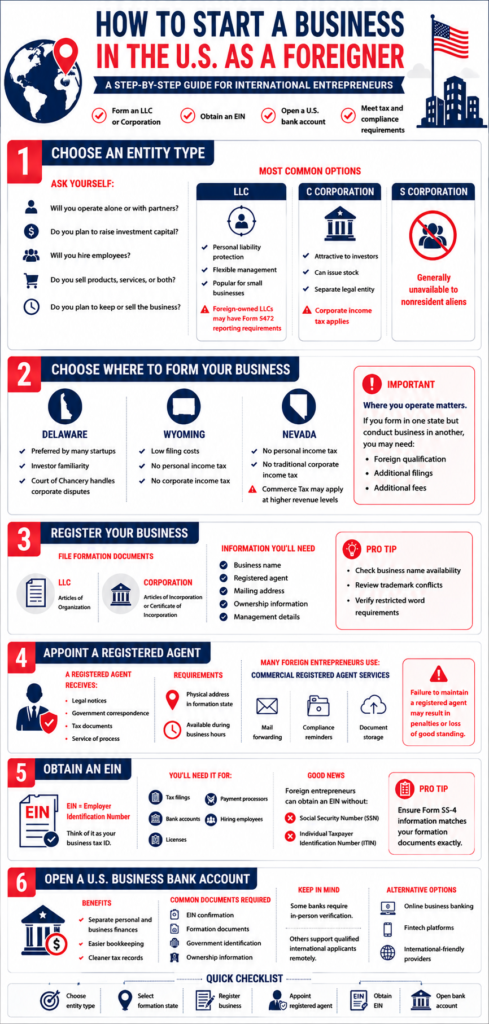
Step 1: Determine Your Business Goals and Choose an Entity Type
The entity type you choose affects taxation, ownership rights, management responsibilities, investor participation, and reporting obligations. To ensure that you make the right decision, ask yourself a few questions:
- Will you operate on your own or with partners?
- Do you plan to seek outside investment?
- Will you hire employees in the United States?
- Will you sell products, provide services, or do both?
- Do you expect to keep the business for the long term or sell it in the future?
For foreign entrepreneurs, the two most common choices are the limited liability company (LLC) and the C corporation. Each has different legal, tax, and ownership arrangements that you’ll want to know before making a decision.
Limited Liability Company (LLC)
An LLC is a popular option for consultants, freelancers, online sellers, service providers, and privately owned businesses. It creates a legal separation between business obligations and personal assets, which generally protects members from company debts and legal claims.
Members can manage daily operations themselves or appoint managers to handle those responsibilities. This gives you flexibility in how the organization is run. As for tax treatment, it varies based on ownership and any elections filed with the IRS. For example, certain foreign-owned LLCs must file IRS Form 5472 and maintain related records under Treasury Regulations Section 1.6038A-2. Reviewing those obligations before formation can help prevent filing issues later.
C Corporation
A C corporation exists as a separate legal entity from its shareholders. It can own property, enter contracts, incur debts, and continue operating even when ownership changes. This option is frequently selected by businesses seeking outside investment because shares can be issued to investors. Startups planning to raise capital from venture capital firms or institutional investors frequently use this entity type.
Pro Tip: Unlike most LLCs, a C corporation pays corporate income tax on its earnings. Shareholders may also owe tax on dividends received from the corporation.
What About S Corporations?
Under U.S. tax law, nonresident aliens can’t be shareholders of an S corporation. As a result, foreign founders usually choose between an LLC and a C corporation when forming a U.S. business.
Step 2: Choose the Right State for Business Formation
Filing fees, annual reporting obligations, tax rules, and corporate laws vary by jurisdiction. As a result, your formation location can affect both startup expenses and ongoing administrative requirements. Three of the top choices are Delaware, Wyoming, and Nevada.
Delaware
Delaware is a leading choice for corporations. Its corporate laws are well established, and the Delaware Court of Chancery resolves corporate disputes through judges rather than juries. Its extensive body of case law provides important guidance for companies, investors, and legal professionals.
Startups that plan to raise outside funding often incorporate in Delaware. Venture capital firms, institutional investors, and attorneys are familiar with Delaware corporate law and the procedures associated with Delaware corporations. That familiarity can reduce friction during due diligence, investment negotiations, shareholder approvals, and other corporate transactions.
Wyoming
Wyoming attracts many small business owners because of its relatively low formation costs and annual fees. The state also doesn’t impose a personal income tax or a corporate income tax. These tax policies make it an attractive option for many privately owned companies. Wyoming also requires less public disclosure of ownership information than some jurisdictions, which some entrepreneurs view as an advantage when evaluating formation options.
Nevada
Nevada does not impose a personal state income tax and does not levy a traditional corporate income tax on most businesses. As a result, many entrepreneurs include Nevada when comparing potential formation jurisdictions. It is often evaluated alongside Delaware and Wyoming because all three are known for attracting new business formations.
However, Nevada has filing fees and reporting obligations that should be reviewed carefully. The state also imposes a Commerce Tax on certain businesses that exceed revenue thresholds. Comparing total costs before filing can help prevent unexpected expenses later.
Consider Where Your Business Activities Will Take Place
The formation location is only part of the decision. While many entrepreneurs focus on formation costs, it’s equally important to consider where the company will actually conduct business. Overlooking this issue can lead to registration, reporting, and compliance challenges later.
Please note that if your company operates, hires employees, maintains an office, or conducts substantial activities elsewhere, additional registration requirements may apply. This process, commonly known as foreign qualification, has rules that vary by state and the nature of the activities being conducted.
To see how this works in practice, consider a Delaware company that conducts business in California. In that situation, the company may need to register there as a foreign entity and comply with California tax and filing rules. As a result, it could face additional fees, annual reports, and administrative responsibilities. Similar requirements may apply in other states as well.
Step 3: Register Your Business Entity
After choosing an entity type and filing location, you’ll need to register the business with the appropriate government agency. This filing officially creates the legal entity under local law. Although rules differ across jurisdictions, most filings request similar information about ownership, management, and contact details.
For an LLC, the primary filing document is usually called the Articles of Organization. Corporations generally submit Articles of Incorporation or a Certificate of Incorporation. Once the filing is accepted, the government agency responsible for business registrations issues confirmation that the entity has been created.
These documents usually request information such as the business name, registered agent, mailing address, management details, and information about organizers or incorporators. Some jurisdictions may need additional disclosures depending on the type of entity being formed. Reviewing the filing requirements before submission can help prevent delays and rejected applications.
Pro Tip: Most jurisdictions require your business name to be distinguishable from other entities already on record. Certain words, including terms associated with banking, insurance, or regulated professions, may need additional approval before they can be used.
Before submitting your filing, check name availability through the appropriate business registration office. This can help prevent delays if the name you want is already in use. It’s also wise to think about trademark issues early, particularly if you plan to market products or services across multiple states.
Note: A name approved by a state filing office does not automatically create trademark rights. Another company may have trademark protections that limit your ability to use a similar name in commerce. Researching potential conflicts before launch can help you avoid rebranding expenses, website changes, marketing revisions, and legal disputes later.
Many jurisdictions now allow online filing, which can reduce processing times. Approval periods vary based on filing volume, government workloads, and any expedited options that may be available. Once registration is complete, you’ll be ready to take other steps, like appointing a registered agent, obtaining an Employer Identification Number (EIN), and opening a business bank account.
Step 4: Appoint a Registered Agent
Most states require LLCs and corporations to designate a registered agent when the business is formed. A registered agent is an individual or company authorized to receive legal documents, government correspondence, tax notices, and service of process on behalf of the entity. The registered agent’s information is included in the formation filing and becomes part of the company’s official records.
The registered agent must maintain a physical address in the state where the business is registered. In most cases, a post office box can’t be used as the registered office address. The agent must also be available during normal business hours to receive important documents when they are delivered.
This rule can create challenges for foreign entrepreneurs who don’t live in the United States or maintain a physical presence in the state where the entity is formed. As a result, many business owners pay for a commercial registered agent service like the registered agent services offered at USA Tax Gurus. We accept official correspondence, notify owners when documents are received, and help ensure important notices are not missed. Our registered agent services start at $199 and include a virtual business address.
When comparing registered agent providers, pay attention to reliability, responsiveness, annual fees, and the services included with the subscription. Some providers like USA Tax Gurus also offer compliance reminders, document storage, mail forwarding, and business filing assistance. Reviewing these features before making a selection can help you identify a provider that meets your needs.
Failing to maintain a registered agent can create administrative problems for a business. In some jurisdictions, the state may impose penalties, revoke good standing status, or begin administrative dissolution proceedings if a company no longer maintains a valid registered agent. Keeping this information current is an important part of ongoing compliance.
Step 5: Obtain an EIN From the IRS
After forming your business, you’ll want to get an Employer Identification Number (EIN) from the Internal Revenue Service (IRS). An EIN is a federal tax identification number used to identify a business for tax and reporting purposes. Many financial institutions, payment processors, and government agencies require an EIN before they will work with a company.
An EIN serves a role similar to a Social Security Number for a business. Companies use it when filing federal tax returns, opening business bank accounts, applying for licenses, hiring employees, and completing various financial transactions. Even businesses that don’t have employees may still need an EIN for banking and tax reporting purposes.
Foreign entrepreneurs can obtain an EIN even if they don’t have a Social Security Number (SSN) or an Individual Taxpayer Identification Number (ITIN). The IRS allows foreign applicants to request an EIN by submitting Form SS-4.
Pro Tip: When completing Form SS-4, make sure that the information provided on the application matches the details listed in the formation documents and other business records.
Keep copies of your EIN confirmation notice after it is issued. Banks, payment processors, accountants, and government agencies may request this document in the future. Maintaining organized records can make future applications, filings, and compliance activities much easier to manage.
Step 6: Open a U.S. Business Bank Account
Keeping business and personal funds separate makes accounting easier and helps create a clear financial record of company activity. It can also simplify tax reporting and support the legal separation between the business and its owners.
Banks and financial institutions usually request several documents before opening an account. Requirements vary, but many institutions ask for formation documents, an EIN confirmation letter, identification documents, and information about the owners. Some banks may also request an operating agreement, corporate bylaws, or additional documentation related to ownership and business activities.
Foreign entrepreneurs sometimes encounter additional requirements during the account opening process. Certain banks want owners to appear in person, while others have procedures that accommodate international applicants. Because policies vary widely between institutions, it is helpful to review account guidelines before scheduling an appointment or submitting an application.
Pro Tip: Traditional banks are not the only option. Financial technology companies and online business banking platforms have expanded the number of choices available to entrepreneurs. Some providers support remote account opening for eligible applicants and offer services tailored to businesses with international ownership.
Common Tax & Compliance Mistakes Foreign Founders Make
Starting a U.S. business as a foreign entrepreneur creates exciting opportunities, but overlooking certain compliance requirements can lead to unnecessary costs and penalties. Here are some of the most common mistakes we see:
1. Assuming a Delaware LLC Means No U.S. Tax Obligations
Many foreign founders believe that forming a Delaware LLC eliminates U.S. filing requirements. In reality, federal tax and reporting obligations may still apply depending on the ownership structure and business activities.
2. Missing Form 5472 Filing Requirements
Foreign-owned single-member LLCs are often required to file Form 5472 and a pro forma Form 1120. Failure to comply can result in penalties starting at $25,000 per year, even if the business has little or no revenue.
3. Mixing Personal and Business Finances
Using personal accounts for business transactions can create bookkeeping challenges and make tax reporting more difficult. Keeping finances separate from day one helps maintain cleaner records and simplifies compliance.
4. Ignoring State Registration and Sales Tax Requirements
Federal compliance is only part of the picture. Depending on where your business operates, stores inventory, or generates sales, additional state registrations, filings, or sales tax obligations may apply.
5. Delaying Proper Bookkeeping
Many founders wait until tax season to organize their records. Maintaining accurate books throughout the year not only supports compliance but also provides better visibility into the financial health of the business.
Questions About Opening a Business in the US?
If you’re planning to start a business in the United States, professional guidance can help you identify filing requirements, evaluate tax considerations, and establish a strong foundation for future growth. USA Tax Gurus assists foreign entrepreneurs with entity formation, EIN applications, tax planning, compliance services, bookkeeping, and ongoing business support. To get started or schedule a consultation, please fill out our contact form or call 213-204-8737 today.
FAQs About Starting a U.S. Business as a Foreigner
Can I Start a U.S. Business Without Living in the United States?
Yes. Foreign nationals can form and own many types of U.S. business entities without residing in the country. In many cases, business formation documents can be filed remotely, and ownership does not require U.S. citizenship or permanent residency. However, owning a company does not automatically grant permission to live or work in the United States.
Do I Need a U.S. Address?
Not always. Formation rules vary by jurisdiction, and many foreign entrepreneurs use commercial addresses or professional service providers for certain business functions. Most states do require a registered agent with a physical address in the state where the entity is formed.
Can I Open a U.S. Business Bank Account Remotely?
It depends on the financial institution. Some banks want owners to appear in person before opening an account, while others have procedures that accommodate international applicants. Account requirements, verification procedures, and documentation standards vary between providers.
Will Starting a Business Help Me Obtain a Visa?
Forming a company does not automatically provide a visa or immigration benefits. Business ownership and immigration status are governed by different rules. If you plan to live and work in the United States, you should review available immigration options with a qualified attorney.
Do I Need to File U.S. Tax Returns if My Business Has No Income?
Possibly. Some businesses have filing and reporting obligations even when they generate little or no revenue. The answer depends on the entity type, ownership arrangement, and reporting rules that apply to the business.
Foreign-owned single-member LLCs, for example, may still have federal reporting obligations, including Form 5472 filing requirements in certain situations. State filing obligations may also continue regardless of revenue levels. Reviewing your filing responsibilities each year can help prevent penalties and missed deadlines.