

Key Takeaways:
- Fiverr income is taxable even if you don’t receive a 1099-K. Most freelancers report business income and qualifying expenses on Schedule C and may also owe self-employment tax.
- The current federal Form 1099-K threshold is over $20,000 in payments and over 200 transactions. Falling below that threshold doesn’t make your Fiverr earnings tax-free.
- Fiverr fees and other qualifying business expenses can reduce taxable profit. Deductible costs may include platform fees, software, equipment, advertising, professional fees, and eligible home office expenses.
- Self-employment tax can apply when net earnings from self-employment reach $400. Federal income tax is calculated separately, so freelancers may owe both.
- Estimated tax payments may be required during the year. If Fiverr is a side business, increasing withholding from a W-2 job may also help cover your tax liability.
- Accurate records are important when reconciling Fiverr earnings and tax forms. Keep earnings statements, 1099s, bank records, fee records, receipts, and other documentation that supports the income and deductions reported on your return.
If you earn money selling services on Fiverr, your tax return may look different from that of a W-2 wage earner. Fiverr freelancers operate as independent contractors, which means you may need to report your Fiverr income, deduct qualifying business expenses, calculate self-employment tax, and make estimated tax payments during the year.
When you receive your Form 1099-K from the platform, you’ll likely have questions. The federal reporting rules have changed several times in recent years, and outdated information about $600 or $5,000 thresholds still appears online. How do you complete the form accurately? Who can help?
At USA Tax Gurus, we help freelancers and other self-employed taxpayers report business income, claim allowable deductions, and calculate estimated taxes. This guide explains how Fiverr income is taxed, when you may receive a 1099-K, how to report your earnings, and which expenses may reduce your taxable business profit.
Do Fiverr Freelancers Have to Pay Taxes?
Yes. If you earn money by providing services through Fiverr, that income is generally taxable. You may need to report it even if freelancing is a side business, you also have a W-2 job, or Fiverr doesn’t send you a tax form.
Most Fiverr freelancers who operate as sole proprietors report their business income and qualifying expenses on Schedule C- Profit or Loss From Business, which is filed with Form 1040. The amount left after deductible business expenses is your net business profit. That figure can affect both your federal income tax and your self-employment tax.
Self-employment tax applies when your net earnings from self-employment are $400 or more. It helps fund Social Security and Medicare and is separate from regular federal income tax. Depending on where you live, you may also owe state or local income taxes or other business-related taxes.
Fiverr doesn’t treat freelancers as employees or withhold federal income tax, Social Security tax, or Medicare tax from their earnings. That means you’re responsible for tracking your income, keeping records of deductible expenses, and paying the tax you owe.
Pro Tip: A Form 1099-K can help document part of your Fiverr income, but receiving one isn’t what makes the income taxable. You must report taxable Fiverr earnings even when your payments fall below the federal 1099-K reporting threshold.
Does Fiverr Send Freelancers a 1099?
Fiverr may issue a Form 1099-K – Payment Card and Third Party Network Transactions, to U.S. freelancers who meet the reporting requirements. Fiverr also requires freelancers who qualify as U.S. persons for tax purposes to submit Form W-9 information, including their taxpayer identification information. Fiverr states that U.S. tax authorities may request a freelancer’s W-9, Form 1099-K, and information about activity on the platform.
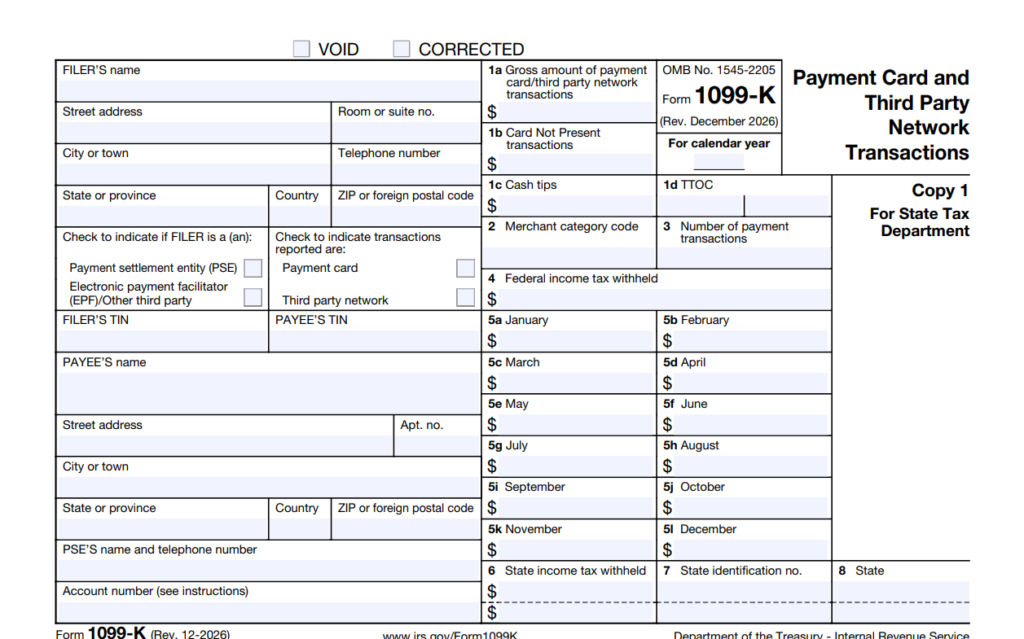
What Is Form 1099-K?
Form 1099-K is an information return used to report certain payments received through payment cards and third-party settlement organizations, including online marketplaces and freelance platforms. The form reports gross payment amounts processed through the platform. It doesn’t calculate your taxable business profit or subtract business expenses for you.
If you receive a Fiverr 1099-K, compare it with your Fiverr records and your own bookkeeping before preparing your return. The amount shown on the form may differ from the amount deposited into your bank account because platform fees and other adjustments can affect what you actually receive.
Does Fiverr Send Form 1099-NEC?
Fiverr’s current tax guidance for U.S. freelancers refers to Form 1099-K for platform earnings. You may still receive a Form 1099-NEC from clients or businesses that paid you outside Fiverr.
Keep the payment source in mind when reviewing your tax forms. If income already recorded in your books also appears on a 1099, you shouldn’t add it to your business income a second time simply because you received the form. The goal is to report your total taxable business income once while reconciling the information returns issued under your taxpayer identification number.
What Is the Fiverr 1099-K Threshold?
For federal tax reporting, a third-party settlement organization must issue Form 1099-K when your gross payments for goods or services exceed $20,000, and you have more than 200 transactions during the calendar year. Both conditions must be met for the federal threshold to apply.
For example, if you receive $25,000 through Fiverr in 150 transactions, you haven’t crossed the federal transaction threshold. If you receive $15,000 in 250 transactions, you haven’t crossed the federal payment threshold. In either case, Fiverr or another payment settlement entity may still issue Form 1099-K even when the federal threshold hasn’t been met.
Why You May See Different 1099-K Thresholds Online
The federal threshold changed several times before returning to the current rule. The American Rescue Plan Act reduced it, and the IRS later delayed and phased in that change. Federal legislation enacted in 2025 then reinstated the prior threshold of more than $20,000 and more than 200 transactions. That history explains why you may still see articles referring to $600 or $5,000 thresholds. However, those figures don’t reflect the current federal threshold for third-party settlement organizations.
State Reporting Rules May Be Different
The federal threshold doesn’t control every state reporting requirement. Some states have their own information-reporting rules, so you may receive a Form 1099-K even when your Fiverr activity falls below the federal threshold.
Most importantly, the reporting threshold doesn’t determine if your Fiverr income is taxable. The IRS states that changes to Form 1099-K reporting thresholds don’t change the taxability of income. If your Fiverr earnings are taxable, you must report them even when you don’t receive Form 1099-K.
Do You Have to Report Fiverr Income If You Don’t Receive a 1099?
Yes. You must report taxable Fiverr income even if Fiverr doesn’t issue you a Form 1099-K.
The 1099-K threshold controls when certain payment settlement entities have a federal reporting obligation. It doesn’t create an income-tax exemption for freelancers who earn less than that amount. If you receive payment for services through Fiverr, that income is reportable on your tax return.
For example, suppose you earn $8,000 from 150 Fiverr transactions during the year. You may fall below the current federal Form 1099-K threshold, but the $8,000 doesn’t become tax-free because no form arrives. The IRS requires taxpayers to report taxable income from gig work and freelance services even when they don’t receive an information return.
Your records are especially important when no 1099 is issued. Keep documents that show what you earned and what Fiverr deducted, including:
- Fiverr earnings statements
- Bank statements
- Payment-account records
- Invoices
- Bookkeeping reports
- Records of platform fees
- Other Forms 1099 you receive
You should reconcile those records before filing rather than relying only on tax forms. That helps you report your total business income once and claim deductions for qualifying expenses.
How Do You Report Fiverr Income on Your Tax Return?
As we indicated earlier, most Fiverr freelancers who operate as sole proprietors report their business income and expenses on Schedule C, Profit or Loss From Business, which is attached to Form 1040.
Start by determining your total Fiverr business income for the year. Compare your Fiverr earnings records, bank deposits, bookkeeping reports, and any Form 1099-K you receive. Don’t assume the amount deposited into your bank account is the same as your gross business income because Fiverr fees and other adjustments can reduce the amount you receive.
Report Gross Business Income
Schedule C starts with your business income. If your records show that clients paid $30,000 for your Fiverr services and Fiverr retained $6,000 in platform fees, you may need to report the full gross income of $30,000 before separately accounting for deductible business expenses.
Subtract Qualifying Business Expenses
Schedule C also allows you to deduct business expenses that meet federal tax requirements. Depending on your work, those deductions may include Fiverr fees, software subscriptions, advertising, equipment, professional fees, and the business-use portion of certain phone or internet costs.
Your net profit is calculated as:
Gross business income – deductible business expenses = net business profit
That net profit flows through to your Form 1040 and may also be subject to self-employment tax.
Calculate Self-Employment Tax
If your net earnings from self-employment are $400 or more, you must use Schedule SE to calculate Social Security and Medicare taxes. Self-employment tax is separate from regular federal income tax. Because Fiverr doesn’t withhold these taxes for freelancers, you may need to make estimated tax payments during the year or increase withholding from another source of income.
Are Fiverr Fees Tax Deductible?
Fiverr fees can qualify as deductible business expenses when they’re ordinary and necessary expenses of your freelance activity. For many freelancers, that includes the portion Fiverr keeps from client payments before the remaining earnings become available for withdrawal.
Fiverr currently states that freelancers receive 80% of the purchase amount for completed orders, including Gig Extras and tips. If a client pays $1,000 and Fiverr retains $200, you may receive $800. For tax reporting, though, you shouldn’t assume that $800 is automatically the correct amount to report as gross business income. Your records and any Form 1099-K you receive should be reviewed together.
If the $1,000 is properly included in your gross business receipts and the $200 Fiverr charge qualifies as a business expense, you may deduct that $200 on Schedule C. That leaves $800 before accounting for any other allowable business expenses.
Pro Tip: Keep records showing both the amount clients paid and the fees Fiverr retained. Fiverr earnings statements, transaction histories, bookkeeping reports, and bank records can help support the amounts reported on your return.
The same principle can apply to other platform-related charges you incur while earning Fiverr income. Their deductibility depends on the nature of the charge and its connection to your business activity.
What Expenses Can Fiverr Freelancers Deduct?
Fiverr freelancers can deduct business expenses that are ordinary and necessary for their trade or business. The IRS defines an ordinary expense as one that is common and accepted in the taxpayer’s field, while a necessary expense is helpful and appropriate for the business. Personal expenses aren’t deductible, and mixed-use costs must be divided between business and personal use.
The deductions available to you depend on the services you provide and the expenses you incur. A graphic designer may have different deductions from a voice actor, writer, programmer, or video editor.
Software and Online Services
Subscriptions and digital tools used for your Fiverr work can qualify as business expenses. Examples may include:
- Adobe Creative Cloud
- Canva
- Grammarly
- Stock photo or video subscriptions
- Cloud storage
- Project-management software
- Accounting software
- Website hosting
- Domain registration
If you use a service for both business and personal purposes, deduct only the business portion.
Computers and Business Equipment
Computers, monitors, microphones, cameras, drawing tablets, lighting equipment, printers, and similar items may qualify for a deduction when purchased for your business.
The tax treatment depends on the item and how it’s used. Some property may be deducted through depreciation or other tax provisions rather than claimed as a regular operating expense. Schedule C instructions specifically distinguish business equipment and furniture from ordinary operating expenses.
Internet and Phone Costs
You may deduct the business portion of internet and phone expenses used for Fiverr work. If you use the same internet connection or phone for personal activities, you need a reasonable method for separating the business portion from the personal portion.
Advertising and Marketing
Expenses incurred to promote your freelance business may be deductible. These can include online advertising, portfolio websites, business cards, promotional materials, and fees paid for marketing services.
Legal, Accounting, and Tax Fees
Fees paid to attorneys, accountants, and other professionals for services related to your business can qualify for a deduction. The Schedule C instructions also permit deductions for tax advice related to the business and tax preparation fees attributable to business tax forms.
Education Expenses
Some education expenses connected to your current freelance work may be deductible. The tax treatment depends on what the education is for. Courses that maintain or improve skills used in your existing business may qualify, while education that prepares you for a new trade or business is treated differently.
Home Office Expenses
If you work from home, you may qualify for a home office deduction. For many self-employed taxpayers, the area must be used regularly and exclusively for business and meet the other applicable requirements.
Pro Tip: The IRS provides both a regular method and a simplified method. Under the simplified method, qualifying taxpayers can use a rate of $5 per square foot for up to 300 square feet, producing a maximum deduction of $1,500 under that method.
Good records are important for each deduction. Keep receipts, invoices, account statements, and calculations showing the business portion of mixed-use expenses. Those records can help support the amounts you report on Schedule C.
How Much Self-Employment Tax Do Fiverr Freelancers Pay?
If you earn net profit from Fiverr, you may owe self-employment tax in addition to federal income tax. Self-employment tax funds Social Security and Medicare for people who work for themselves.
The self-employment tax rate is 15.3%, made up of:
- 12.4% for Social Security
- 2.9% for Medicare
The calculation isn’t based on your gross Fiverr revenue. It applies to your net earnings from self-employment after allowable business expenses are taken into account. The Schedule SE calculation also applies a statutory adjustment before the tax is computed.
Pro Tip: You usually must file Schedule SE if your net earnings from self-employment are $400 or more for the year.
The Social Security portion is subject to an annual wage base. If you also have W-2 wages, those wages count toward that limit. The Medicare portion doesn’t use the same wage cap, and higher-income taxpayers may also owe Additional Medicare Tax once their income exceeds the applicable threshold.
You can also deduct one-half of your self-employment tax when calculating adjusted gross income. That deduction doesn’t reduce the self-employment tax itself, but it can reduce your federal income tax.
For example, if your Fiverr business earns $40,000 after deductible expenses, self-employment tax is calculated on your net earnings under Schedule SE rules, not simply by multiplying $40,000 by 15.3%. Your federal income tax is calculated separately based on your taxable income, filing status, deductions, credits, and other income.
Do Fiverr Freelancers Need to Pay Quarterly Estimated Taxes?
Fiverr doesn’t withhold federal income tax or self-employment tax from your freelance earnings. Because federal taxes are paid throughout the year, you may need to make estimated tax payments rather than waiting until you file your return. The IRS uses Form 1040-ES – Estimated Tax for Individuals to calculate these payments.
For 2026, you may need to make estimated tax payments if both of these conditions apply:
- You expect to owe at least $1,000 in tax after subtracting withholding and refundable credits.
- Your withholding and refundable credits are expected to be less than the smaller of 90% of your 2026 tax liability or 100% of your 2025 tax liability. Different percentages can apply to some higher-income taxpayers and people with farming or fishing income.
Estimated tax payments can cover both federal income tax and self-employment tax. The IRS divides the year into four payment periods, each with its own due date. Paying too little during the year can lead to an underpayment penalty, even if you later pay the full balance when filing your return.
For additional guidance, please check out our Estimated Quarterly Tax Payments Calculator.
What If Fiverr Is a Side Hustle?
If you have a W-2 job in addition to Fiverr income, you may be able to increase the federal tax withheld from your paycheck instead of making separate estimated payments. You can submit a new Form W-4 to your employer and request additional withholding. This can be useful when your Fiverr earnings fluctuate throughout the year: the goal is to pay enough tax through withholding, estimated payments, or a combination of the two.
How Do You Estimate What to Pay?
Form 1040-ES uses your expected income, deductions, credits, self-employment tax, and withholding to estimate your annual tax liability. Your prior-year return can serve as a starting point, but you should update the calculation if your Fiverr income changes during the year.
If your freelance income rises or falls, you can recalculate your remaining payments. Keeping your tax estimate current can reduce the chance of a large balance due or an underpayment penalty at filing time.
What If Your Fiverr 1099-K Doesn’t Match Your Earnings?
A Form 1099-K may show a number that differs from the amount you transferred to your bank account. That doesn’t necessarily mean the form is wrong. It can reflect gross reportable payments before Fiverr fees, refunds, adjustments, or other amounts reduce what you actually receive.
Start by comparing the form with your Fiverr earnings history, annual statements, bank records, and bookkeeping reports. Look for differences caused by:
- Fiverr service fees
- Refunds or canceled orders
- Timing differences between payment and withdrawal
- Multiple payout methods
- Adjustments made after a transaction
- Duplicate or incorrect reporting
- Incorrect taxpayer information
If the 1099-K is accurate, your tax return should still distinguish between gross business income and deductible expenses. A higher gross amount on the form doesn’t mean the entire amount is taxable profit.
If the form contains an error, contact Fiverr or the issuer shown on the form and request a correction. The IRS advises taxpayers to keep records showing that they tried to resolve an incorrect Form 1099-K. You shouldn’t ignore the form simply because you disagree with the amount, because the IRS may have received the same information.
If you can’t get a corrected form before filing, you may need to report the income and adjustment in a way that accurately reflects your records. In that situation, documentation is especially important, and a tax professional can help you decide how to present the discrepancy on the return.
How Are Tips on Fiverr Taxed?
Tips you receive through Fiverr are taxable income. For self-employed workers, the IRS treats tips received from customers as business income, including tips paid through third-party platforms. They’re reported with your other business receipts on Schedule C and can also be subject to self-employment tax.
Fiverr states that freelancers earn 80% of the purchase amount for completed orders, including Gig Extras and tips. That means tips are part of your Fiverr earnings rather than a separate tax-free payment.
For example, if a client pays $500 for a project and adds a $100 tip, you need to account for the tip when calculating your business income. Fiverr’s fee also applies to tips under its current earnings policy, so your records should show both the gross amount and the platform fee deducted from it.
Keep tip income in the same bookkeeping records you use for your other Fiverr payments. Tracking it separately from the base order price can also make it easier to reconcile your earnings statement and Form 1099-K at tax time.
A separate federal deduction for certain qualified tips exists for tax years 2025 through 2028, but it applies only when the statutory requirements are met, including occupational eligibility and reporting requirements. Fiverr freelancers shouldn’t assume that every tip received through the platform qualifies for that deduction.
What If You Earn Money on Fiverr and Other Platforms?
Many freelancers use Fiverr along with other marketplaces, payment apps, and direct client arrangements. If you also earn money through Upwork, Freelancer, PayPal, Venmo business transactions, your own website, or direct invoices, you need to account for all taxable business income across those sources.
You may receive several tax forms during the year, including multiple Forms 1099-K and Forms 1099-NEC. Those forms are reporting documents. They don’t create separate categories of taxable income by themselves, and you shouldn’t add the same payment twice if it already appears in your bookkeeping.
For example, a client might pay you directly and issue Form 1099-NEC, while other clients pay through Fiverr and generate Form 1099-K reporting. Your records should identify where each payment came from so you can reconcile the forms without duplicating income.
If the income comes from the same trade or business, you may report it together on one Schedule C rather than treating each platform as a separate business. If you operate distinct businesses, separate Schedule C filings may be appropriate.
Keep records for each income source, including:
- Platform earnings statements
- Forms 1099-K and 1099-NEC
- Direct invoices
- Bank deposits
- Payment-app records
- Refunds and adjustments
- Platform fees
- Business expenses
The goal is to report your total taxable business income once and match that amount to the records and information returns connected to your taxpayer identification number.
Get Help With Fiverr and Freelance Taxes From USA Tax Gurus
Fiverr income can create several tax obligations at once, from Schedule C reporting and self-employment tax to estimated payments and Form 1099-K reconciliation. If you earn through several platforms, have business expenses to claim, or receive a tax form that doesn’t match your records, careful reporting becomes even more important.
At USA Tax Gurus, we help freelancers review their income, deductions, tax forms, and filing obligations. We can also help you compare entity options, plan estimated payments, address prior-year reporting errors, and respond to IRS notices connected to freelance income. If you earn money through Fiverr and want help preparing your return or planning for future tax payments, book a meeting with us today or call 213-668-6316 and see how we can help.
Frequently Asked Questions About Fiverr Taxes
Do Fiverr Freelancers Need an LLC?
No. You don’t need to form an LLC just because you earn money through Fiverr.
If you start freelancing without creating another business entity, you may operate as a sole proprietor for federal tax purposes. You can report business income and expenses on Schedule C using your individual tax return.
An LLC is a legal entity created under state law. For federal income tax purposes, a single-member LLC is usually treated as a disregarded entity unless it elects another tax classification. That means the owner may still report the business on Schedule C even after forming the LLC.
As your Fiverr income grows, you may want to review other options, including:
- Remaining a sole proprietor
- Operating through a single-member LLC
- Electing S corporation tax treatment
- Forming a partnership if you have another owner
- Using a C corporation in limited situations
At USA Tax Gurus, we can compare entity options based on your profit, other income, payroll needs, state rules, and long-term business plans before you change how your Fiverr business is taxed.
Can Fiverr Freelancers Claim the Qualified Business Income Deduction?
Fiverr freelancers who operate a sole proprietorship or another eligible pass-through business may qualify for the qualified business income deduction, also called the Section 199A deduction. Eligible taxpayers can deduct up to 20% of qualified business income from a domestic trade or business.
Qualified business income is based on eligible net business income, not your gross Fiverr revenue. Several deductions connected to the business reduce that figure, including:
- The deductible portion of self-employment tax
- Self-employed health insurance deductions
- Qualifying retirement plan contributions
Beginning with the 2026 tax year, OBBBA created a minimum QBI deduction of $400 for taxpayers who have at least $1,000 of qualified business income from an active trade or business in which they materially participate. For a freelancer who actively runs their own Fiverr business, this means a small but profitable operation can still receive a meaningful deduction. The $400 and $1,000 amounts will be adjusted for inflation starting in 2027.
Income Thresholds and Phase-In Ranges
The deduction has several limitations once your taxable income rises above certain levels. Your taxable income, business type, W-2 wages paid by the business, and qualified property can affect the amount you can claim.
For 2026, the income thresholds are:
- $403,500 for married couples filing jointly
- $201,775 for married taxpayers filing separately
- $201,750 for all other filers
OBBBA also widened the phase-in ranges above those thresholds. The ranges are now $150,000 for joint filers and $75,000 for other filers, up from $100,000 and $50,000. That means the limitations phase in fully at $553,500 for joint filers and $276,750 for most other filers. The wider ranges make the reduction more gradual as your income grows.
Service Businesses Face Additional Limits
Some types of work are classified as specified service trades or businesses (SSTBs). For Fiverr freelancers, SSTB fields can include:
- Consulting
- Performing arts, such as voice acting
- Other services where the business relies mainly on the owner’s skill or reputation
If your taxable income is below the threshold, SSTB status doesn’t limit your deduction. Within the phase-in range, the deduction for SSTB income gradually decreases. Above the range, it is eliminated entirely.
Whether your specific Fiverr services count as an SSTB depends on the nature of the work. It’s worth reviewing with a tax professional as your income grows.
Note: The deduction doesn’t reduce your self-employment tax. It reduces taxable income for federal income tax purposes after the applicable calculation is completed.
Eligible taxpayers may use Form 8995 or Form 8995-A to calculate the deduction, depending on their income and other tax factors.
What Records Should Fiverr Freelancers Keep?
Good records help you report Fiverr income accurately, support business deductions, and reconcile tax forms with your own books. You should keep documentation that shows both what you earned and what you spent on your freelance business.
Useful records include:
- Fiverr earnings statements
- Forms 1099-K
- Forms 1099-NEC from other clients
- Bank statements
- Payment-app statements
- Fiverr fee records
- Invoices
- Software subscription receipts
- Equipment purchase receipts
- Advertising expenses
- Professional fees
- Home office records
- Internet and phone business-use calculations
- Estimated tax payment confirmations
- Prior-year tax returns
Fiverr provides earnings information through its Financial Documents area, which can help you compare annual platform records with your own bookkeeping.