


The Foreign Account Tax Compliance Act (FATCA) was passed in 2010 to prevent U.S. taxpayers from using foreign accounts and offshore assets to evade taxes. For individual taxpayers, compliance normally means filing Form 8938 – Statement of Specified Foreign Financial Assets when those asset values exceed a certain amount. However, FATCA can also affect businesses, foreign financial institutions, and other entities.
At USA Tax Gurus, we help U.S. taxpayers, expatriates, business owners, and international entities understand and comply with their FATCA obligations. We can also review and correct errors in prior returns. Because FATCA reporting can overlap with FBAR and other international tax returns, we examine each applicable filing separately so your U.S. tax reporting addresses all relevant federal obligations.
Why Hire USA Tax Gurus for FATCA Compliance Services?
FATCA compliance can be labor-intensive. You may need to determine which foreign assets are reportable, calculate their values in U.S. dollars, apply the correct filing threshold, prepare Form 8938, and review related filings such as the FBAR. USA Tax Gurus provides FATCA compliance services that can help keep you in good standing with the IRS.
| Service | Benefit |
| International Tax Preparation and Review | FATCA is part of the broader U.S. international tax system, so a foreign account or investment may trigger several reporting duties. We can review how FATCA applies alongside your federal income tax return and other international filings. This is especially useful when your foreign financial activity involves several countries, account types, or ownership interests. |
| Detailed Foreign Asset Review | Form 8938 touches on foreign financial assets you own or have an interest in. That can include foreign bank accounts, brokerage accounts, stock issued by foreign corporations, partnership interests, and certain contracts or financial instruments. We review your records to determine which assets fall within FATCA reporting rules, how ownership affects reporting, and which assets may be reported elsewhere on your federal return. |
| Accurate Filing Threshold Calculations | Form 8938 thresholds vary based on filing status and where you live. A married couple filing jointly in the United States faces different thresholds from an unmarried taxpayer living abroad, and the rules consider both year-end values and values reached at any point during the tax year. USA Tax Gurus reviews account balances, investment values, foreign currency conversions, and filing status before determining if Form 8938 is required. |
| Coordination With Other International Filings | Some taxpayers must file both Form 8938 and an FBAR. Ownership in a foreign corporation or partnership, dealings with a foreign trust, receipt of certain foreign gifts, or other cross-border activity can also trigger separate federal information returns. USA Tax Gurus reviews the reporting duties tied to your foreign activity so each form is prepared correctly. |
| Help Correcting Prior-Year Reporting | You may discover that a foreign account, investment, or ownership interest should have appeared on a prior tax return. USA Tax Gurus can review previous filings, identify affected tax years, determine which forms were omitted, and prepare amended filings when necessary. |
What Is FATCA?
The Foreign Account Tax Compliance Act, commonly called FATCA, is a federal tax law enacted in 2010 as part of the Hiring Incentives to Restore Employment Act. Its purpose is to increase reporting of foreign financial accounts and assets connected to U.S. taxpayers. FATCA addresses both U.S. taxpayers who hold certain foreign financial assets and foreign financial institutions that maintain accounts connected to U.S. persons.
For U.S. taxpayers, FATCA generally requires certain individuals and domestic entities to report specified foreign financial assets when their total value exceeds the applicable filing threshold. Reporting is completed on Form 8938, which is attached to the filer’s annual return. Reportable assets can include:
- Accounts maintained by foreign financial institutions
- Stock or securities issued by foreign persons (when held for investment outside a financial account)
- Interests in foreign entities
- Certain financial instruments
- Contracts with foreign counterparties
FATCA also imposes separate requirements on certain foreign financial institutions and non-financial foreign entities. Depending on their FATCA classification, these entities may have reporting, registration, documentation, or withholding duties tied to U.S. account holders or owners. The institutional rules fall primarily under Chapter 4 of the Internal Revenue Code, while Form 8938 reporting for U.S. taxpayers arises under a separate FATCA provision.
Note: FATCA reporting concerns disclosure as well as income taxation. If you’re required to file Form 8938, you may have to report a qualifying foreign financial asset even when that asset doesn’t increase your tax liability for the year.
Who Needs to Comply With FATCA?
For Form 8938 purposes, you generally must file if you’re a specified person, you have an interest in specified foreign financial assets, and the aggregate value of those assets exceeds the reporting threshold. Foreign financial institutions and certain foreign entities have a separate set of FATCA rules tied to classification, account reporting, documentation, registration, and withholding.
- U.S. Citizens With Foreign Financial Assets: U.S. citizens are specified individuals under the Form 8938 rules. If you own reportable foreign financial assets and their aggregate value exceeds the threshold that applies to your filing status and residence, you may have to file Form 8938 with your annual federal return. This can apply to U.S. citizens living in the United States and those living abroad.
- Resident Aliens: A resident alien who is treated as a U.S. resident for tax purposes during any part of the tax year is also a specified individual. Residency can arise under the green card test or substantial presence test. If you hold specified foreign financial assets during the applicable reporting period and their aggregate value exceeds your filing threshold, Form 8938 may be required. Assets acquired before you became a U.S. tax resident can still be relevant once they fall within the reporting period.
- Certain Nonresident Aliens: Most nonresident aliens aren’t specified individuals for Form 8938 purposes, but there are exceptions. A nonresident alien who elects to be treated as a resident alien to file a joint federal income tax return can fall within the Form 8938 rules. A nonresident alien who is a bona fide resident of American Samoa or Puerto Rico can also qualify as a specified individual.
- Specified Domestic Entities: A domestic corporation or partnership can qualify as a specified domestic entity when it is closely held by a specified individual and at least 50% of its gross income is passive income or at least 50% of its assets produce or are held to produce passive income. A domestic trust can qualify as a specified domestic entity when it has one or more specified persons as current beneficiaries.
- Foreign Financial Institutions: FATCA also reaches certain foreign financial institutions, including banks, custodial institutions, investment entities, and qualifying insurance companies. Depending on their classification and the rules governing the jurisdiction where they operate, an institution may need to identify U.S. accounts, register for FATCA purposes, report account information, maintain documentation, or comply with an applicable intergovernmental agreement.
- Certain Non-Financial Foreign Entities: Certain non-financial foreign entities can also have FATCA requirements under Chapter 4. A passive NFFE that receives a withholdable payment may need to identify its substantial U.S. owners or certify that it has none. If the entity fails to provide the required documentation and no exception applies, the payment can be subject to FATCA withholding. Active NFFEs and other excepted NFFEs are treated differently.
What Foreign Financial Assets Are Reported Under FATCA?
Form 8938 applies to specified foreign financial assets rather than every asset you own outside the United States. Some assets are reported because they are maintained by a foreign financial institution, while others are reportable because they are held for investment outside a financial account.
- Foreign Financial Accounts: This category can include checking accounts, savings accounts, brokerage accounts, certain equity or debt interests in foreign financial institutions, and certain cash-value insurance or annuity contracts. If you hold several foreign financial accounts, their values are generally considered together when determining if you exceed the Form 8938 filing threshold.
- Foreign Stocks and Securities: Stock or securities issued by a foreign person can be reportable when you hold them for investment outside a financial account. This can include shares of foreign corporations and certain foreign bonds or similar securities. If the same investments are held inside a foreign brokerage account, the account itself may be the reportable asset rather than each security within it.
- Interests in Foreign Entities: An ownership interest in a foreign corporation, foreign partnership, foreign trust, or certain other foreign entities can also fall within the Form 8938 rules when held for investment. Reporting can depend on the nature of the interest and how it is held. Separate international information returns may also apply to the same foreign entity, so Form 8938 should be reviewed alongside any other filing duties tied to that ownership interest.
- Certain Foreign Financial Instruments and Contracts: Some financial instruments and contracts involving a foreign issuer or counterparty can also qualify as specified foreign financial assets when held for investment outside a financial account. Examples can include certain notes, bonds, swaps, and other financial arrangements. The classification depends on the terms of the instrument and the identity of the issuer or counterparty.
Assets That May Be Excluded From Form 8938 Reporting
Not every foreign-related account or asset belongs on Form 8938. Accounts maintained by a U.S. payer generally aren’t specified foreign financial assets. This can include accounts at a domestic branch of a foreign bank or foreign insurance company, as well as certain accounts maintained by a foreign branch or foreign subsidiary of a U.S. financial institution.
Because Form 8938 applies to specified foreign financial assets, some foreign property falls outside its scope when you hold it directly rather than through a financial account or a foreign entity. Foreign real estate held directly in your own name generally isn’t a specified foreign financial asset and isn’t reported on Form 8938. The same is true of foreign currency held directly. Other directly held tangible assets, such as art, jewelry, vehicles, and precious metals held directly, generally follow the same principle. The treatment can change once an asset is held through a foreign entity: an ownership interest in a foreign corporation, partnership, or trust can itself be a reportable interest, even though the underlying real estate would not be reportable if you held it directly.
Different reporting rules can also apply when a specified foreign financial asset is already reported on another international information return. If the asset is timely reported on certain forms, including Forms 3520, 3520-A, 5471, 8621, or 8865, you generally don’t report the asset again in the asset sections of Form 8938. Instead, you identify the applicable form in Part IV of Form 8938.
USA Tax Gurus can review each foreign account, investment, and ownership interest separately to determine how it should be treated under FATCA. This review is especially important when the same asset is connected to several federal reporting rules or is held through a foreign entity rather than directly in your name.
Understanding Form 8938
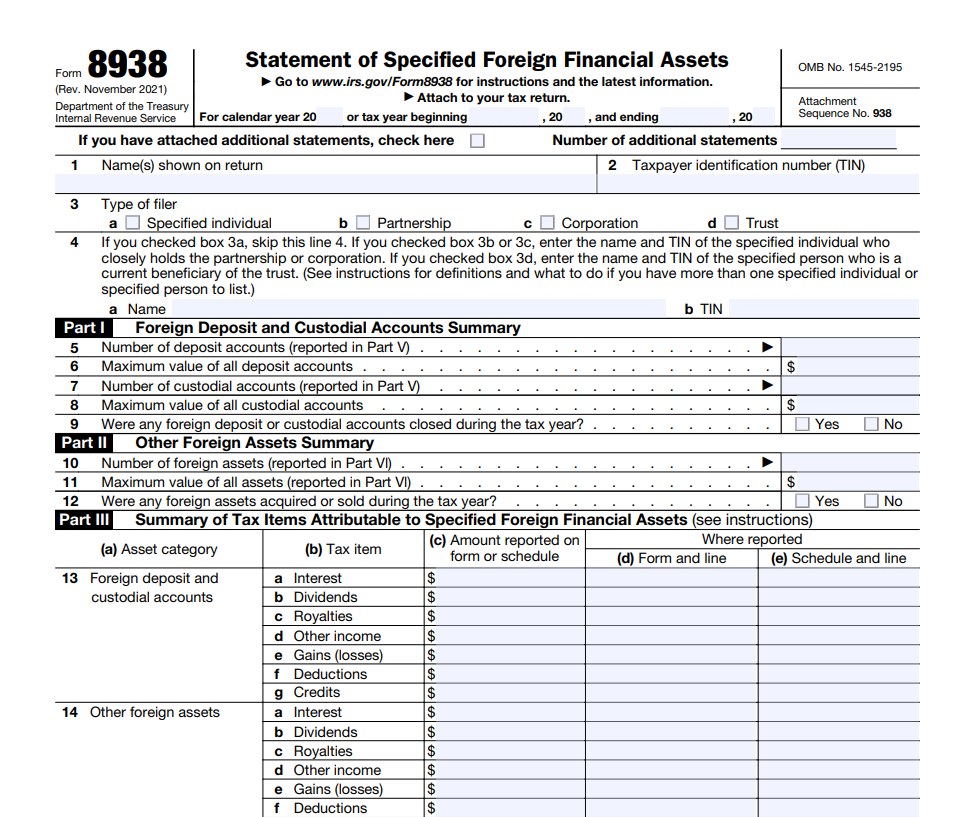
Form 8938, Statement of Specified Foreign Financial Assets, is the IRS form used by specified individuals and specified domestic entities to report qualifying foreign financial assets when the applicable filing threshold is exceeded. The form is attached to the filer’s annual return and is due on the same date as that return, including any applicable extension. You don’t file Form 8938 as a stand-alone filing.
For each reportable account or asset, Form 8938 generally calls for identifying information and the maximum value during the tax year. Depending on the asset, you may also need to report information about the financial institution, issuer, foreign entity, income connected to the asset, and other tax forms on which related income, gain, loss, deductions, or credits appear. Assets already reported on certain international information returns can receive different treatment on Form 8938, but they may still need to be identified in Part IV.
The value reported for a foreign financial asset is generally its fair market value:
- For a financial account, you can usually rely on periodic statements to determine the maximum annual value unless you know or have reason to know that those statements don’t provide a reasonable estimate.
- For an asset held outside a financial account, you may generally use its value on the last day of the tax year unless readily accessible information shows that figure isn’t a reasonable estimate of the asset’s maximum value during the year.
If reliable information shows that the asset reached a higher value during the year, that higher amount should be used. The IRS doesn’t generally require you to obtain an independent third-party appraisal solely to prepare Form 8938.
Pro Tip: Foreign-currency values must be converted to U.S. dollars. In most cases, the IRS directs filers to use the U.S. Treasury Bureau of the Fiscal Service exchange rate for the last day of the tax year, even if an account was closed or an asset was sold before year-end. If the Treasury doesn’t publish a rate for the currency involved, another publicly available exchange rate can be used and disclosed on the form.
What Are the FATCA Filing Thresholds?
As we’ve already explained, Form 8938 filing thresholds depend on your filing status, where you live, and the total value of your specified foreign financial assets. The IRS applies both a year-end test and an anytime-during-the-year test. Exceeding either applicable amount can trigger a Form 8938 filing duty when the other filing requirements are met.
Taxpayers Living in the United States
If you live in the United States and you’re unmarried, you generally must file Form 8938 when the total value of your specified foreign financial assets is greater than $50,000 on the last day of the tax year or $75,000 at any time during the year.
If you’re married and file a joint return, the threshold increases to $100,000 on the last day of the tax year or $150,000 at any time during the year. Married taxpayers filing separate returns generally use the same $50,000 year-end and $75,000 anytime-during-the-year thresholds that apply to unmarried taxpayers.
Taxpayers Living Outside the United States
Higher thresholds apply if your tax home is in a foreign country and you meet the applicable residence or physical-presence test. A U.S. citizen can qualify by being a bona fide resident of a foreign country or countries for an uninterrupted period that includes the entire tax year. A U.S. citizen or resident can also qualify by being physically present in one or more foreign countries for at least 330 full days during a 12-month period ending in the tax year.
If you qualify as living abroad and you file a return other than a joint return, Form 8938 is generally required when your specified foreign financial assets exceed $200,000 on the last day of the tax year or $300,000 at any time during the year. If you’re married and filing jointly, those amounts increase to $400,000 at year-end or $600,000 at any point during the year.
Specified Domestic Entities
A qualifying domestic corporation, partnership, or trust generally must file Form 8938 when its specified foreign financial assets exceed $50,000 on the last day of the tax year or $75,000 at any time during the year. The entity must first meet the applicable definition of a specified domestic entity before these thresholds apply.
Specified domestic entities also use different aggregation rules for certain assets reported on other international information returns. In some cases, assets reported on qualifying forms such as Forms 5471, 8621, or 8865 aren’t included again when determining if the entity exceeds the Form 8938 threshold. That treatment differs from the rules that generally apply to specified individuals.
Why Values During the Entire Year Count
The filing test doesn’t depend solely on what you own on December 31. An account, investment, or other reportable asset can push you above the threshold earlier in the year even if its value falls before year-end or you dispose of it before the tax year closes. For that reason, calculating your filing obligation can require reviewing maximum annual values rather than relying solely on year-end statements.
For example, an unmarried taxpayer living in the United States could have $45,000 in reportable foreign assets on December 31 but still need to file Form 8938 if those assets exceeded $75,000 earlier in the year. The same rule can apply when an account is closed, an investment is sold, or an ownership interest changes during the tax year.
Special Rules for Married Taxpayers
Married couples filing jointly generally file one Form 8938 reporting the specified foreign financial assets in which either spouse has an interest. Married taxpayers filing separately use lower thresholds. If both spouses are specified individuals and they file separate returns, each spouse generally includes one-half of the value of a specified foreign financial asset they jointly own when determining if the filing threshold has been exceeded.
If Form 8938 is required, each spouse generally reports the entire maximum value of the jointly owned asset on the separate Form 8938. This distinction between the threshold calculation and the amount reported on the form can affect both filing determinations and the values shown on each spouse’s return.
FATCA vs. FBAR: What Is the Difference?
As you’ve seen, FATCA reporting on Form 8938 and the Report of Foreign Bank and Financial Accounts, commonly called the FBAR, are separate federal reporting requirements. You may need to file one, both, or neither depending on your status, the types of foreign assets or accounts you hold, and their values. Filing Form 8938 doesn’t satisfy an FBAR obligation, and filing an FBAR doesn’t replace Form 8938.
Form 8938 is filed with the IRS as part of your annual federal return. The FBAR is FinCEN Form 114 and is filed electronically with the Financial Crimes Enforcement Network through its BSA E-Filing System. It isn’t filed with your federal income tax return.
| Requirement | FATCA / Form 8938 | FBAR / FinCEN Form 114 |
| Who Files | Specified individuals and specified domestic entities that meet the applicable asset-value threshold | U.S. persons with a financial interest in, or signature authority over, qualifying foreign financial accounts when the reporting threshold is met |
| Reporting Threshold | Varies according to filing status, residence, and filer type | Generally applies when the aggregate value of foreign financial accounts exceeds $10,000 at any time during the calendar year |
| What Is Reported | Specified foreign financial assets, including certain foreign accounts and certain foreign investments held outside financial accounts | Foreign financial accounts maintained by financial institutions located outside the United States |
| Where It Is Filed | With the IRS as part of the filer’s annual return | Electronically with FinCEN |
| Due Date | Same due date as the filer’s annual return, including applicable extensions | April 15, with an automatic extension to October 15 |
| Signature Authority | Signature authority by itself generally doesn’t create a Form 8938 reporting duty | Signature authority can create an FBAR filing duty, subject to applicable exceptions |
Because the definitions and thresholds differ, the same foreign bank or investment account can appear on both forms while another asset may belong on only one. USA Tax Gurus can review your foreign financial activity under both sets of rules and determine which filings apply rather than assuming that completing one foreign account disclosure satisfies the other.
FATCA Requirements for Foreign Financial Institutions
FATCA imposes separate obligations on certain foreign financial institutions, or FFIs. These rules are aimed at identifying accounts and financial relationships connected to U.S. persons. An institution’s duties depend on its classification, the jurisdiction where it operates, and any FATCA intergovernmental agreement that applies there.
Determining FFI Status
A foreign entity can qualify as an FFI if it falls within categories such as a depository institution, custodial institution, investment entity, or certain insurance companies. Classification matters because it affects registration, due diligence, reporting, and withholding duties. Some entities qualify for exempt or deemed-compliant treatment, while others must satisfy additional FATCA requirements.
FATCA Registration
Certain FFIs must register with the IRS through the FATCA registration system. Registration is used to establish the institution’s FATCA status and, when applicable, obtain a Global Intermediary Identification Number. Some institutions register individually, while others may be registered through a lead financial institution or sponsoring entity depending on the arrangement.
Global Intermediary Identification Numbers
A GIIN is an identification number the IRS issues to certain entities that complete FATCA registration. It can be used by withholding agents and other institutions to verify an entity’s FATCA status against the IRS FFI list.
An entity may need a GIIN for account opening, withholding documentation, reporting, or dealings with financial institutions and counterparties. USA Tax Gurus can review whether registration is required, assist with the application, and help maintain registration information when updates are needed.
Identifying and Reporting U.S. Accounts
Certain FFIs must perform due diligence to identify accounts held by U.S. persons or foreign entities with reportable U.S. owners. Depending on the governing FATCA rules, the institution may need to collect tax documentation, review account-holder information, and report qualifying account data.
The reporting method depends in part on the jurisdiction. In some countries, financial institutions report information to the local tax authority, which then exchanges the information with the United States. In others, participating institutions may report directly to the IRS.
Intergovernmental Agreements
The United States has entered into FATCA intergovernmental agreements with many jurisdictions. These agreements generally follow either a Model 1 or Model 2 approach.
- Under a Model 1 agreement, qualifying financial institutions generally report FATCA information to their local tax authority, which then exchanges the information with the IRS.
- Under a Model 2 agreement, qualifying institutions generally report certain information directly to the IRS, subject to the terms of the agreement and local law.
These agreements can change registration, reporting, and due-diligence requirements. USA Tax Gurus can review the applicable FATCA classification and reporting route before registration or filing work begins.
Learn More About Our FATCA Compliance Services at USA Tax Gurus
FATCA can affect a wide range of U.S. taxpayers, domestic entities, foreign financial institutions, and businesses. USA Tax Gurus can review your foreign accounts, investments, ownership interests, entity status, and prior filings to determine which FATCA requirements apply. If you need help with FATCA compliance, contact us to discuss your reporting duties and the filings required for your situation. Book a meeting with us today or call 213-668-6316 and see how we can help.
FAQs About FATCA Compliance Services
What Are the FATCA Withholding Requirements?
A withholdable payment generally includes certain U.S.-source fixed or determinable annual or periodical income, commonly called FDAP income. Examples can include interest, dividends, rents, royalties, and certain other payments from U.S. sources. Current Chapter 4 withholding generally doesn’t apply to gross proceeds from the sale or disposition of property.
A 30% withholding rate can apply to certain withholdable payments made to a nonparticipating foreign financial institution or to certain foreign entities that fail to provide the required FATCA documentation. For a passive NFFE, withholding can apply if the entity doesn’t disclose its substantial U.S. owners or certify that it has none when required.
The 30% rate doesn’t apply automatically to every payment made to a foreign person. The payee’s FATCA classification, the type of payment, applicable Chapter 4 exceptions, and any relevant intergovernmental agreement can affect the result.
What Happens If You Fail to Comply With FATCA?
If you’re required to file Form 8938 and don’t submit a complete and correct form by the due date, including extensions, the IRS can impose a $10,000 penalty. If the IRS sends you a notice and you still don’t file a correct Form 8938 within 90 days, an additional $10,000 penalty can apply for each 30-day period, or part of a 30-day period, that the failure continues. The maximum additional continuation penalty is $50,000.
Failing to report a specified foreign financial asset can also affect the tax due on your return. If an underpayment results from a transaction involving an undisclosed specified foreign financial asset, a 40% accuracy-related penalty can apply to that underpayment. Examples can include unreported taxable distributions from a foreign corporation, unreported gain from the sale of foreign stock, or taxable distributions from a foreign pension that weren’t disclosed as required.
Foreign entities face different FATCA consequences under Chapter 4. A withholding agent generally must withhold 30% of a withholdable payment made to an FFI unless the institution qualifies for treatment as a participating FFI, deemed-compliant FFI, exempt beneficial owner, or another applicable category. A foreign entity that isn’t an FFI can also face 30% withholding when it fails to identify its substantial U.S. owners or certify that it has none and no exception applies.
A failure to file Form 8938 or to disclose a specified foreign financial asset generally won’t result in a penalty if you can show the failure was due to reasonable cause and not to willful neglect. Whether reasonable cause applies is determined based on all the facts and circumstances. Keep in mind that the IRS doesn’t treat a foreign jurisdiction’s disclosure restrictions (like local laws that would impose civil or criminal penalties for revealing the information) as reasonable cause on their own.
USA Tax Gurus can review missed Form 8938 filings, prior returns, foreign income, entity classifications, and Chapter 4 documentation to determine what needs to be corrected. We can then prepare the applicable filings and address related international reporting duties under the rules governing each tax year or entity.
Does Living Outside the U.S. Exempt Me From FATCA?
No. U.S. taxpayers living abroad may still need to file Form 8938 if their specified foreign financial assets exceed the applicable thresholds. Higher reporting thresholds generally apply to taxpayers who qualify as living abroad.
What If I Forgot to File Form 8938 in a Prior Year?
If you were required to file Form 8938 but missed it, penalties may apply. USA Tax Gurus can review the affected years, determine what needs to be corrected, and help prepare the appropriate amended filings.
Do I Need to File Both Form 8938 and an FBAR?
Yes, you may need to file both. Form 8938 and the FBAR are separate reporting requirements with different thresholds and rules. Filing one does not satisfy the requirement to file the other.