

Key Takeaways:
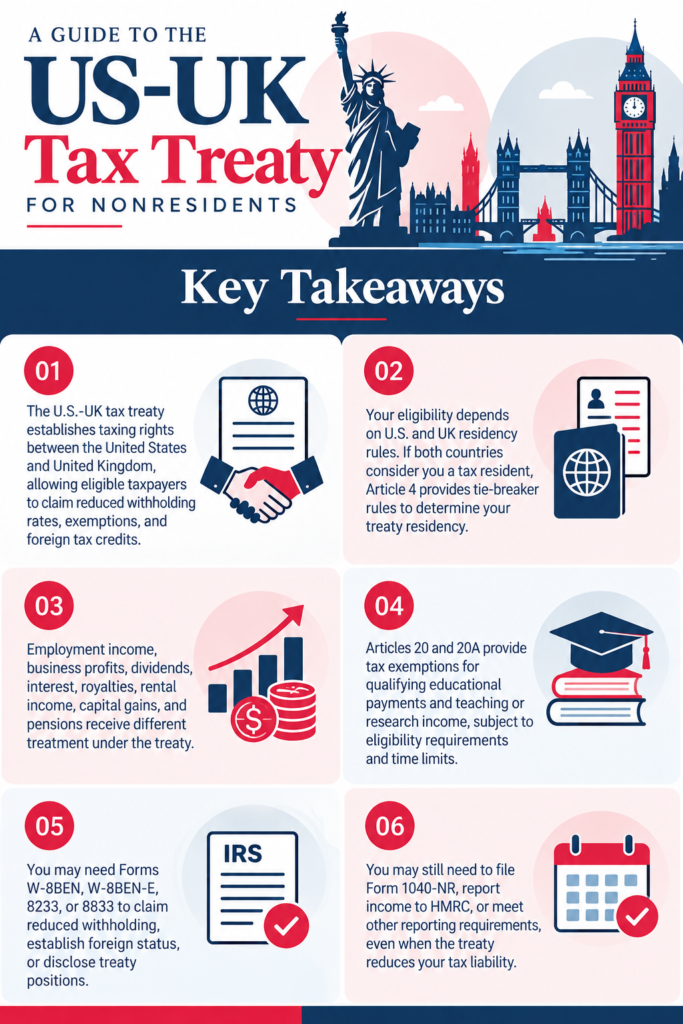
- The U.S.-UK tax treaty establishes taxing rights between the United States and United Kingdom, allowing eligible taxpayers to claim reduced withholding rates, exemptions, and foreign tax credits.
- Your eligibility depends on U.S. and UK residency rules. If both countries consider you a tax resident, Article 4 provides tie-breaker rules to determine your treaty residency.
- Employment income, business profits, dividends, interest, royalties, rental income, capital gains, and pensions receive different treatment under the treaty.
- Articles 20 and 20A provide tax exemptions for qualifying educational payments and teaching or research income, subject to eligibility requirements and time limits.
- You may need Forms W-8BEN, W-8BEN-E, 8233, or 8833 to claim reduced withholding, establish foreign status, or disclose treaty positions.
- You may still need to file Form 1040-NR, report income to HMRC, or meet other reporting requirements, even when the treaty reduces your tax liability.
If you live in the United Kingdom but earn income from the United States, you may have tax obligations in both countries. It’s the same situation if you’re a U.S. citizen living and working in the UK. Depending on your residency status and the type of income you receive, you may have to deal with U.S. withholding taxes, foreign income reporting requirements, and specific filing obligations. Fortunately, the U.S.-UK tax treaty establishes rules that help eligible taxpayers avoid double taxation and claim reduced tax rates or exemptions.
At USA Tax Gurus, we help individuals and businesses manage their U.S. tax obligations when they have income or financial interests that cross international borders. In this guide, we’ll explain how the U.S.-UK tax treaty works, who qualifies for its benefits, which types of income receive preferential treatment, and how to claim available tax relief while meeting IRS reporting requirements.
USA Tax Gurus is a team of enrolled agents and licensed CPAs who can help you take control of your business finances to maximize profits, reduce taxes, and provide increased financial clarity. We’re QuickBooks Pro Advisors, but our tech-savvy team can work in almost any accounting platform, including Wave, Zoho, and more. Schedule your free consultation today with a member of our team to learn more!
What Is the U.S.-UK Tax Treaty?
The U.S.-UK tax treaty is a bilateral agreement between the United States and the United Kingdom that establishes how certain types of income and capital gains are taxed when you have financial interests in both countries. Officially known as the Convention for the Avoidance of Double Taxation and the Prevention of Fiscal Evasion, the agreement was signed on July 24, 2001, amended in 2002, and entered into force on March 31, 2003.
The treaty establishes which country has the right to tax certain income, reduces withholding taxes for qualifying taxpayers, and provides relief when both countries impose taxes on the same income. It also establishes procedures for resolving disputes between the IRS and HM Revenue & Customs (HMRC).
Which Taxes Does the Treaty Cover?
Under Article 2, the treaty applies to several federal taxes in the United States and national taxes in the United Kingdom, including:
- U.S. Federal Income Taxes: Taxes imposed under the Internal Revenue Code.
- U.S. Federal Excise Taxes: Certain taxes involving foreign insurance policies and private foundations.
- UK Income Tax: Taxes on earnings, pensions, rental income, and other taxable income.
- UK Corporation Tax: Taxes on company profits.
- UK Capital Gains Tax: Taxes on gains from the disposal of qualifying assets.
- UK Petroleum Revenue Tax: A tax identified in the treaty that applies to certain oil and gas profits.
The treaty doesn’t apply to U.S. state income taxes or Social Security contributions. Separate agreements and domestic laws govern these obligations.
Who Qualifies for Benefits Under the U.S.-UK Tax Treaty?
Under Article 4, you qualify as a treaty resident if you’re liable for taxation in the United States or United Kingdom because of your residence, citizenship, domicile, or other qualifying connection. However, receiving income from either country doesn’t necessarily establish treaty residency. Your eligibility depends on domestic tax laws, the treaty’s residency provisions, and other requirements.
How US Tax Residency Is Determined
For U.S. federal income tax purposes, foreign nationals are classified as resident aliens or nonresident aliens. You’re normally considered a resident alien if you meet either of these tests:
- Green Card Test: You’re a lawful permanent resident of the United States during the tax year.
- Substantial Presence Test: You’re physically present in the United States for at least 31 days during the current year and 183 days over a three-year period, using the IRS’s weighted calculation.
The substantial presence calculation counts all qualifying days in the current year, one-third of the previous year’s days, and one-sixth of the days from two years earlier. Certain exceptions apply.
How UK Tax Residency Is Determined
The United Kingdom uses the Statutory Residence Test to establish your tax residency. HM Revenue & Customs (HMRC) considers the number of days you spend in the UK, your employment arrangements, your available homes, and your family connections.
The test includes automatic overseas tests, automatic UK tests, and a sufficient ties test. For example, spending at least 183 days in the UK during a tax year establishes UK residency.
What Happens If You’re a Tax Resident of Both Countries?
If both countries classify you as a tax resident, Article 4 has tie-breaker rules to determine your residency for treaty purposes. These rules examine:
- Permanent Home: The country where you have a permanent home available.
- Center of Vital Interests: The country with which you have closer personal and economic connections.
- Habitual Abode: The country where you regularly reside.
- Nationality: Your citizenship when the earlier tests don’t resolve residency.
- Mutual Agreement: A determination reached by the countries’ competent authorities when necessary.
These tests apply in sequence. Establishing treaty residency in one country may change how certain income is taxed, but it doesn’t necessarily eliminate your domestic tax filing obligations.
How the U.S.-UK Tax Treaty Prevents Double Taxation
Article 24 of the U.S.-UK tax treaty establishes rules for relieving double taxation when both countries have the right to tax the same income. Depending on your tax residency, citizenship, and income source, you may qualify for foreign tax credits or other relief that reduces the amount you owe.
Foreign Tax Credits Under Article 24
Foreign tax credits allow eligible taxpayers to offset certain income taxes paid to one country against their tax liability in the other. For example, if you’re a U.S. citizen paying income tax in the UK, you may claim a foreign tax credit against your U.S. federal income tax liability.
Similarly, UK residents who pay qualifying U.S. taxes may receive relief under UK tax law. However, foreign tax credits are subject to limitations, so the amount you can claim may differ from the total foreign taxes paid.
The US Saving Clause
Article 1 contains a saving clause that allows the United States to tax its citizens and treaty residents as though the treaty didn’t exist. Consequently, if you’re a U.S. citizen living in the UK, you remain subject to U.S. federal income tax on your worldwide income.
However, certain treaty provisions remain available despite the saving clause, including qualifying double taxation relief under Article 24. You may also qualify for foreign tax credits or the foreign earned income exclusion under U.S. domestic tax law, provided you meet the applicable requirements.
Example of Double Taxation Relief
Suppose you’re a UK resident receiving U.S.-source investment income. If the United States imposes a withholding tax and the UK also taxes that income, you may qualify for UK foreign tax credit relief.
For example, if you receive $10,000 in U.S. dividends, a qualifying treaty claim may reduce U.S. withholding from 30% to 15%. You may then qualify for a UK foreign tax credit for the U.S. tax paid, subject to applicable limitations. This reduces the possibility of paying the full amount of tax in both countries.
How Different Types of Income Are Taxed Under the U.S.-UK Tax Treaty
The U.S.-UK tax treaty establishes different tax rules for employment earnings, business profits, investment income, real estate, and retirement benefits. If you’re a UK resident receiving U.S.-source income, your tax liability depends on the type of payment, your treaty eligibility, and the provisions that apply to that income.
Employment Income: Article 14
Under Article 14, your employment income is taxable in your country of residence unless you perform your work in the other country. For example, if you live in the UK but travel to the United States for work, the United States may tax the wages attributable to your American workdays.
However, you may qualify for an exemption if you meet all three conditions:
- You spend no more than 183 days in the other country during any 12-month period beginning or ending in the relevant tax year.
- Your employer isn’t a resident of the country where you temporarily work.
- Your compensation isn’t paid by or on behalf of a permanent establishment your employer maintains in that country.
If you fail to meet these conditions, the country where you perform your employment may tax the associated income.
Business Profits and Self-Employment Income: Article 7
Article 7 allows business profits to be taxed only in the country where the business is resident, unless it operates through a permanent establishment in the other country.
A permanent establishment, as defined under Article 5, refers to a fixed place of business, such as an office, branch, or workshop. Certain dependent agents may also create a permanent establishment.
For example, if you’re a UK-based consultant providing services remotely to American clients, your business profits may be exempt from U.S. federal income tax under the treaty if you qualify for its benefits and have no U.S. permanent establishment. However, establishing a U.S. office or conducting business through certain agents may change your tax obligations.
Dividends: Article 10
Dividends paid by American companies to foreign investors are subject to 30% U.S. withholding under domestic tax law. Article 10 reduces this rate for qualifying UK residents.
The principal treaty rates are:
- 15%: The general maximum withholding rate for qualifying individual investors and other recipients.
- 5%: Available to qualifying corporate shareholders that own at least 10% of the dividend-paying company’s voting power.
- 0%: Available to certain qualifying parent companies and eligible pension schemes that satisfy additional treaty conditions.
For example, if you’re a UK resident receiving $10,000 in dividends from American stocks, the treaty may reduce U.S. withholding from $3,000 to $1,500. You must establish your eligibility and provide the appropriate withholding documentation.
Interest: Article 11
Article 11 provides that interest arising in one country and beneficially owned by a resident of the other country is taxable only in the recipient’s country of residence.
Consequently, qualifying UK residents may receive U.S.-source interest without U.S. withholding tax. Exceptions apply to certain income attributable to a permanent establishment, profit-dependent interest, and arrangements subject to the treaty’s anti-abuse provisions.
Royalties: Article 12
Article 12 assigns taxing rights over qualifying royalty income to the recipient’s country of residence. Royalties include payments for the use of copyrights, patents, trademarks, and certain other intellectual property.
For example, if you’re a UK resident receiving royalties from an American company for licensing copyrighted material, those payments may qualify for exemption from U.S. withholding tax. Different rules apply when the income is attributable to a U.S. permanent establishment or falls within certain treaty exceptions.
Rental Income and Capital Gains: Articles 6 and 13
Article 6 allows the country where real estate is located to tax income generated by that property. Therefore, if you’re a UK resident earning rental income from an American property, the United States may tax those earnings.
Article 13 similarly permits the United States to tax gains from the sale of U.S. real estate. These transactions may also trigger withholding under the Foreign Investment in Real Property Tax Act (FIRPTA).
Gains from selling other assets, including certain stocks and securities, are taxable only in the seller’s country of residence, subject to treaty exceptions and applicable domestic tax rules.
Pensions, Retirement Income, and Social Security: Articles 17 and 18
Article 17 assigns taxing rights over qualifying private pension payments to the recipient’s country of residence. However, lump-sum payments from pension schemes may be taxable exclusively in the country where the scheme is established.
Social Security payments are taxable only in the recipient’s country of residence under Article 17, subject to the treaty’s saving clause and its exceptions. Government service pensions are addressed separately under Article 19.
Article 18 also contains provisions affecting qualifying retirement plans and pension contributions when people work across borders. These rules may provide tax relief for eligible contributions or investment earnings within qualifying pension schemes.
Overview of U.S.-UK Tax Treaty Income Rules
| Income Type | Treaty Article | General Tax Treatment |
| Employment Income | Article 14 | Taxed where you reside, unless you work in the other country. A 183-day exemption may apply. |
| Business Profits | Article 7 | Taxed in your country of residence unless you have a permanent establishment in the other country. |
| Dividends | Article 10 | U.S. withholding limited to 15%, 5%, or 0%, depending on eligibility. |
| Interest | Article 11 | Taxable only in the beneficial owner’s country of residence, subject to exceptions. |
| Royalties | Article 12 | Taxable only in the beneficial owner’s country of residence, subject to exceptions. |
| Rental Income | Article 6 | The country where the property is located may tax rental income. |
| Capital Gains | Article 13 | Real estate gains may be taxed where the property is located. Other gains follow residence-country rules, with exceptions. |
| Pensions | Article 17 | Regular private pensions taxed in the recipient’s country of residence. Special rules apply to lump sums. |
| Social Security | Article 17 | Taxed in the recipient’s country of residence, subject to the saving clause. |
Source: HMRC: 2001 UK-USA Double Taxation Convention, as Amended by the 2002 Protocol.
The table presents the general rules for qualifying treaty residents. The treaty’s saving clause, limitation on benefits provisions, and applicable exceptions can change the final tax treatment.
Special Tax Treaty Provisions for Students, Teachers, and Researchers
The U.S.-UK tax treaty provides exemptions for qualifying students, business apprentices, professors, and teachers who temporarily travel between the two countries. Articles 20 and 20A establish rules that can reduce tax liability on certain educational payments and compensation for teaching or research.
Tax Benefits for International Students: Article 20
Under Article 20, if you’re a UK resident temporarily studying in the United States, you may qualify for an exemption from U.S. income tax on payments received from outside the country for your maintenance, education, or training.
To qualify, you must have been a UK resident before your visit and be attending a recognized educational institution for full-time study or participating in full-time training. For business apprentices, the exemption is limited to one year from their initial arrival for training purposes.
Note: The exemption doesn’t extend to wages earned from employment in the United States, which are subject to separate tax rules.
Tax Exemptions for Teachers and Researchers: Article 20A
Article 20A provides an exemption for qualifying professors and teachers who temporarily visit the United States or the United Kingdom to teach or conduct research at a recognized educational institution.
If you were a UK resident immediately before visiting the United States, you may qualify for an exemption from U.S. income tax on teaching or research compensation for up to two years. If you stay longer, you may lose the exemption for the entire visit, including the initial two-year period. Research must also serve the public interest rather than primarily benefit a private individual or business.
How to Claim U.S.-UK Tax Treaty Benefits
If you’re a UK resident receiving income from the United States, you may need to submit documentation to claim reduced withholding rates or tax exemptions under the treaty. The IRS requires qualifying taxpayers to establish their residency status, identify the applicable treaty provisions, and complete the appropriate forms.
Step 1: Confirm Your Tax Residency and Eligibility
Before claiming treaty benefits, you must establish that you qualify as a resident under Article 4. You must also identify the treaty article governing your income and meet its eligibility requirements.
Article 23 contains limitation on benefits provisions intended to prevent taxpayers from improperly claiming treaty advantages. These provisions are particularly relevant to companies claiming reduced withholding rates on dividends, interest, or royalties. Certain treaty benefits also depend on beneficial ownership and other eligibility conditions.
Step 2: Submit the Appropriate IRS Form
The IRS uses several forms to document treaty claims. The form you need depends on your taxpayer classification and income type.
- Form W-8BEN: Foreign individuals use this form to establish their non-U.S. status and claim reduced withholding rates or exemptions on qualifying income, including dividends, interest, and royalties.
- Form W-8BEN-E: Foreign entities use this form to establish their tax classification and claim applicable treaty benefits.
- Form 8233: Nonresident alien individuals use this form to claim treaty exemptions from withholding on qualifying compensation for personal services.
- Form 8833: Taxpayers use this form to disclose certain treaty-based return positions when required under U.S. federal tax law.
Forms W-8BEN, W-8BEN-E, and 8233 are submitted to the payer or withholding agent. Form 8833 is filed with the IRS when disclosure is required.
Step 3: File the Appropriate Tax Returns
Claiming treaty benefits doesn’t necessarily eliminate your U.S. tax filing obligations. If you’re a nonresident alien with U.S. income subject to reporting, you may need to file Form 1040-NR.
You may also need to file a return to recover excess withholding or report income that remains taxable under U.S. law. Depending on your filing obligations, you’ll need a Social Security number or Individual Taxpayer Identification Number (ITIN).
Note: UK residents may also have reporting obligations through HMRC’s Self Assessment system.
Step 4: Keep Supporting Documentation
Maintaining accurate records helps substantiate your treaty claims if the IRS requests further information. Relevant documentation includes:
- Proof of U.S. or UK tax residency.
- Forms 1042-S, 1099, and other applicable income statements.
- Employment contracts and business agreements.
- Travel records documenting days spent in each country.
- Records of foreign taxes paid and treaty benefits claimed.
At USA Tax Gurus, we assist individuals and businesses with treaty eligibility reviews, withholding certificates, federal income tax returns, and treaty disclosures. Our international tax services help you meet your U.S. reporting obligations while claiming the tax relief available under the agreement.
Questions About the U.S.-UK Tax Treaty? Speak to USA Tax Gurus
The U.S.-UK tax treaty can help you reduce your tax liability when you earn income in one country while residing in the other. However, you must meet residency requirements, identify the correct treaty provisions, and submit the appropriate tax documentation. Errors can lead to excess withholding, denied exemptions, and bigger IRS obligations.
At USA Tax Gurus, we help individuals and businesses determine their treaty eligibility, claim available tax benefits, and meet their U.S. filing requirements. To discuss your cross-border tax obligations and identify opportunities to reduce your tax liability, book a meeting with us today or call 213-668-6316.
Frequently Asked Questions About the U.S.-UK Tax Treaty
Can I Claim U.S.-UK Tax Treaty Benefits If I Live in the UK but Earn Money From American Clients?
Yes. If you’re a UK tax resident providing freelance or consulting services to American clients, Article 7 may protect your business profits from U.S. federal income tax. For example, if you operate your business from the UK and don’t maintain a permanent establishment in the United States, your qualifying business profits are taxable in the UK under the treaty.
However, if you establish a U.S. office or conduct business through certain agents, the United States may tax profits attributable to that establishment. You must also distinguish independent business income from employment earnings, dividends, royalties, and other payments governed by separate treaty provisions.
Does the U.S.-UK Tax Treaty Eliminate U.S. State Income Tax?
No. The treaty generally governs federal income taxes and does not generally prevent U.S. states from imposing their own income taxes. State tax obligations depend on the applicable state’s rules and your circumstances.
Do U.S. Citizens Living in the UK Still Need to File U.S. Tax Returns?
Generally, yes. U.S. citizens living in the UK remain subject to U.S. tax filing rules on their worldwide income, even if they also pay UK tax. Foreign tax credits and other relief may reduce double taxation, but the filing requirements depend on your income and circumstances.
Do I Need to File a U.S. Tax Return If I Qualify for Treaty Benefits?
Your U.S. filing obligations depend on your tax classification, business activities, and the income you receive. If you’re a nonresident alien engaged in a U.S. trade or business, you may need to file Form 1040-NR even when a treaty exempts your income from U.S. taxation. You must also file a return to request a refund of excess withholding.
However, if you receive only qualifying U.S. investment income and the correct tax has been withheld, a federal return may be unnecessary. Certain treaty positions also require disclosure on Form 8833. Reviewing your filing requirements helps you avoid penalties while claiming the benefits available to you.
Resources:
- https://www.legislation.gov.uk/uksi/2002/2848/schedule/part/I/crossheading/relief-from-double-taxation/made
- https://www.gov.uk/government/publications/usa-tax-treaties/2001-uk-usa-double-taxation-convention-as-amended-by-the-2002-protocol-in-force
- https://www.irs.gov/pub/irs-pdf/fw8ben.pdf
- https://www.irs.gov/forms-pubs/about-form-w-8-ben-e
- https://www.irs.gov/forms-pubs/about-form-8233
- https://www.irs.gov/forms-pubs/about-form-8833