

Key Takeaways:
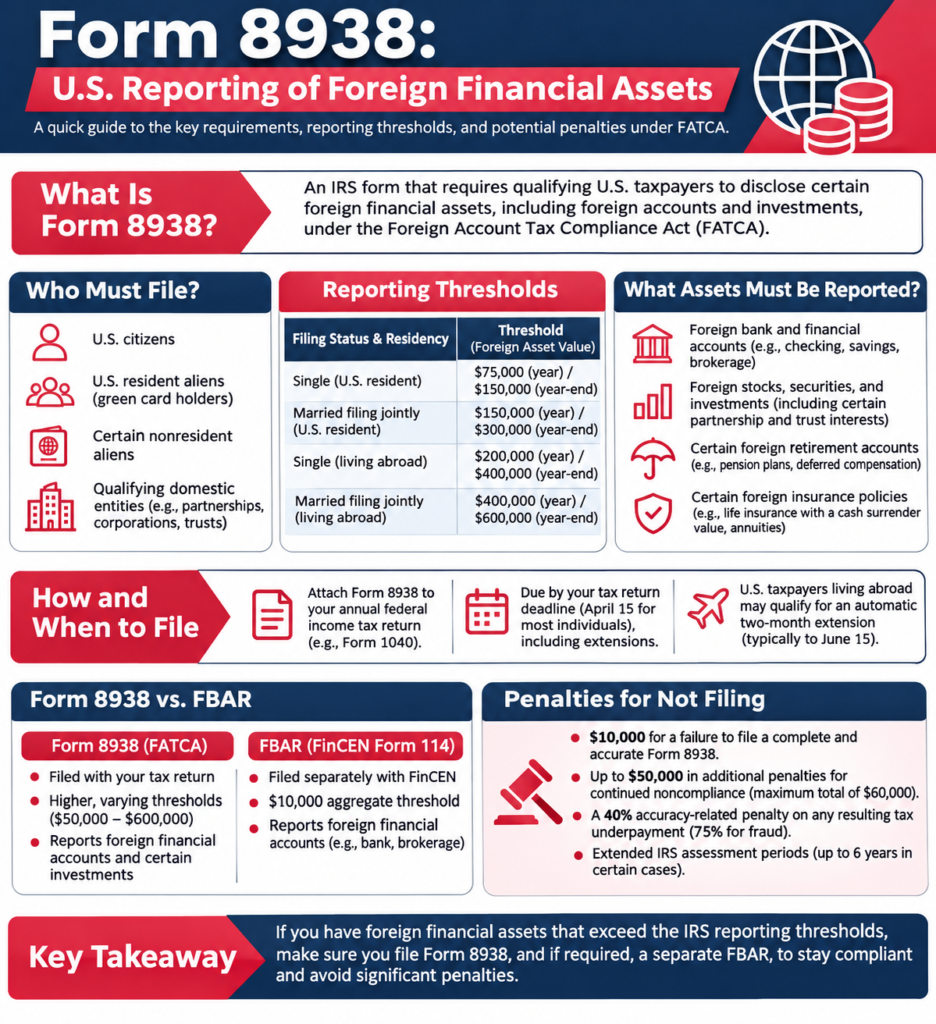
- Form 8938 requires qualifying U.S. taxpayers to disclose foreign financial assets exceeding IRS reporting thresholds under the Foreign Account Tax Compliance Act (FATCA).
- U.S. citizens, resident aliens, certain nonresident aliens, and qualifying domestic entities must file Form 8938 when they meet the applicable filing criteria.
- Reporting thresholds range from $50,000 to $600,000, depending on filing status, residency, and asset values during the tax year.
- Reportable assets include foreign bank accounts, brokerage accounts, securities, certain foreign retirement interests, and qualifying insurance policies.
- Form 8938 must be attached to your annual federal income tax return, and you may also need to file a separate Foreign Bank Account Report (FBAR).
- Failure to file a complete and accurate Form 8938 can result in penalties of up to $60,000, additional tax penalties, and extended IRS assessment periods.
If you hold foreign bank accounts, investments, or other financial assets, you may need to disclose them to the IRS using Form 8938, Statement of Specified Foreign Financial Assets. This form applies to certain U.S. taxpayers whose foreign financial assets exceed established reporting thresholds. Failure to file can result in penalties, even when you’ve reported all your taxable income.
At USA Tax Gurus, we help individual clients, expatriates, and business owners meet their international tax reporting obligations. In this guide, we’ll explain who must file Form 8938, which foreign assets must be disclosed, and how reporting thresholds vary by residency and filing status. We’ll also walk you through completing and submitting the form, explain how it differs from the Foreign Bank Account Report (FBAR), and discuss the penalties for missing or incomplete filings.
USA Tax Gurus is a team of enrolled agents and licensed CPAs who can help you save thousands on taxes. Schedule your free consultation today with a member of our team to learn more!
What Is IRS Form 8938?
IRS Form 8938 is an information return used to disclose certain foreign financial holdings to the Internal Revenue Service. Established under the Foreign Account Tax Compliance Act (FATCA), it requires qualifying U.S. taxpayers to report foreign accounts, investments, and other financial interests when their combined value exceeds the applicable reporting threshold.
Form 8938 is filed with your annual federal tax return. If you’re expected to file, you must disclose qualifying assets even when they haven’t generated income or affected your tax liability for the year.
What Is the Purpose of Form 8938?
Form 8938 helps the IRS identify foreign financial holdings and verify compliance with federal tax reporting requirements. It serves several purposes:
- Foreign Asset Disclosure: Identifies qualifying foreign bank accounts, securities, investments, and other financial interests.
- Income Verification: Helps the IRS compare reported foreign assets with interest, dividends, capital gains, and other income included on your federal tax return.
- Tax Compliance: Supports the IRS in identifying unreported foreign income and enforcing FATCA reporting rules.
- International Financial Reporting: Provides information about financial assets that may fall outside traditional domestic reporting requirements.
Form 8938 doesn’t calculate the tax you owe on foreign assets. Income generated by those assets must be reported separately on the appropriate federal tax forms and schedules. Filing Form 8938 also doesn’t replace your obligation to submit an FBAR if you meet its filing criteria.
Who Must File Form 8938?
You must file Form 8938 if you’re a specified individual or specified domestic entity, have an interest in foreign financial assets exceeding the applicable reporting threshold, and are required to file a federal income tax return. The IRS determines your filing obligation based on your tax residency, the types of assets you hold, and their combined value during the tax year.
U.S. Citizens and Resident Aliens
Form 8938 filing rules apply to the following taxpayers when they meet the reporting criteria:
- U.S. Citizens: You may need to report foreign financial assets regardless of where you live. U.S. citizens residing abroad are subject to different asset reporting thresholds.
- Green Card Holders: If you’re a lawful permanent resident, you’re considered a U.S. resident for federal tax purposes unless an applicable exception changes your status.
- Resident Aliens: If you meet the substantial presence test, you’re treated as a U.S. resident for federal income tax purposes and may have Form 8938 reporting obligations.
- U.S. Expatriates: If you’re a U.S. citizen living and working overseas, you remain subject to FATCA reporting rules. Higher reporting thresholds apply when you satisfy the IRS criteria for taxpayers living abroad.
Certain Nonresident Aliens
Some nonresident aliens must also file Form 8938. This includes those who elect to be treated as U.S. residents for purposes of filing a joint federal income tax return with their spouses.
Note: Nonresident aliens who are bona fide residents of Puerto Rico or American Samoa may also qualify as specified individuals. These taxpayers must file Form 8938 when they have a federal income tax return filing obligation and their reportable foreign financial assets exceed the applicable threshold.
Specified Domestic Entities
Certain U.S. corporations, partnerships, and trusts must report foreign financial assets under FATCA. The criteria include:
- Domestic Corporations: Closely held corporations with at least 80% of total combined voting power or value owned by a specified individual, directly or indirectly, when at least 50% of their gross income is passive income, or at least 50% of their assets produce or are held to produce passive income.
- Domestic Partnerships: Partnerships meeting comparable ownership and passive income or asset requirements.
- Domestic Trusts: Certain trusts with one or multiple specified persons as current beneficiaries, subject to applicable exceptions.
Passive income includes dividends, interest, certain rents and royalties, and other qualifying investment income. The IRS applies additional ownership and attribution rules when determining which entities must file.
When Is Form 8938 Not Necessary?
You don’t have to file Form 8938 if your foreign financial assets remain below the current reporting thresholds or you don’t qualify as a specified person. You also don’t need to submit Form 8938 if you’re not required to file an annual federal income tax return, even when your foreign financial assets exceed the reporting threshold.
However, the absence of a Form 8938 filing obligation doesn’t eliminate other international reporting guidelines. You may still need to file an FBAR or another foreign asset information return, depending on your accounts and financial interests.
What Are the Form 8938 Reporting Thresholds?
The IRS establishes different Form 8938 reporting thresholds based on your filing status and place of residence. You must file when the combined value of your specified foreign financial assets exceeds the applicable threshold on the last day of the tax year or at any point during that year.
Form 8938 Reporting Thresholds for Individuals
| Filing Status | Last Day of Tax Year | Any Time During Tax Year |
| Single, living in the U.S. | Over $50,000 | Over $75,000 |
| Married filing jointly, living in the U.S. | Over $100,000 | Over $150,000 |
| Married filing separately, living in the U.S. | Over $50,000 | Over $75,000 |
| Living abroad, not filing jointly | Over $200,000 | Over $300,000 |
| Married filing jointly, living abroad | Over $400,000 | Over $600,000 |
| Specified domestic entities | Over $50,000 | Over $75,000 |
You only need to exceed one of the two applicable thresholds to trigger the reporting requirement. For example, if you’re unmarried and living in the United States, you must file if your qualifying assets exceed $75,000 during the year, even if their combined value falls below $50,000 by December 31.
How Does the IRS Determine If You Live Abroad?
Higher reporting thresholds apply to qualifying taxpayers residing outside the United States. To qualify, you must have a tax home in a foreign country and meet one of the following criteria:
- Bona Fide Residence Test: You’re a U.S. citizen who has been a bona fide resident of a foreign country or countries for an uninterrupted period that includes an entire tax year.
- Physical Presence Test: You’re a U.S. citizen or resident who has been physically present in a foreign country or countries for at least 330 full days during a period of 12 consecutive months ending in the tax year.
If you don’t meet these criteria, the reporting thresholds for taxpayers living in the United States apply.
How Do You Calculate the Total Value of Your Foreign Assets?
To determine if you exceed the reporting threshold, calculate the combined value of your qualifying foreign financial assets. Follow these valuation rules:
- Aggregate Asset Values: Combine the applicable values of your foreign accounts, investments, and other reportable holdings.
- Use Account Statements: Determine account values using periodic financial statements that reasonably reflect the highest balance during the year.
- Apply Joint Ownership Rules: If you file jointly with your spouse, count jointly owned assets once. If you file separately, you’ll need to count half of the value of the joint assets toward your threshold, but report the full value on the form.
- Convert Foreign Currencies: Convert foreign currency values into U.S. dollars using the applicable year-end exchange rate, ordinarily published by the U.S. Treasury.
- Include Qualifying Non-Account Assets: Determine the fair market value of reportable foreign investments and financial interests, subject to applicable IRS valuation rules.
For example, assume you’re unmarried, live in the United States, and hold $40,000 in a foreign savings account and $45,000 in a foreign brokerage account on December 31. Your combined foreign financial assets total $85,000, exceeding the $50,000 year-end threshold. You must file Form 8938 if you meet the other filing requirements.
Which Foreign Financial Assets Must You Report on Form 8938?
Form 8938 requires you to disclose specified foreign financial assets when their combined value exceeds your reporting threshold. Reportable assets include accounts maintained by foreign financial institutions, investments issued by foreign entities, and certain financial contracts with foreign counterparties. You must report qualifying assets regardless of their income-generating activity during the tax year.
Foreign Bank and Financial Accounts
If you maintain accounts with foreign financial institutions, you must include them on Form 8938 when you meet the filing guidelines. Reportable accounts include:
- Foreign Checking Accounts: Accounts maintained at banks outside the United States for deposits, payments, and everyday transactions.
- Foreign Savings Accounts: Savings accounts, money market deposit accounts, and other qualifying deposit arrangements with foreign banks.
- Foreign Brokerage Accounts: Investment accounts maintained by foreign brokerage firms that hold stocks, bonds, mutual funds, or other securities.
- Foreign Custodial Accounts: Accounts where a foreign financial institution holds cash, securities, or other financial assets on your behalf.
You must disclose qualifying foreign accounts even if they contain investments issued by U.S. companies. However, you don’t need to report each investment separately when it’s held within a reportable foreign financial account.
Foreign Stocks, Securities, and Investments
Certain investments held outside financial accounts must also be reported. These include:
- Stocks and securities issued by foreign corporations.
- Bonds, notes, and other debt instruments issued by foreign persons.
- Ownership interests in foreign partnerships.
- Shares in foreign mutual funds held directly.
- Interests in certain foreign trusts and estates.
- Financial contracts, options, and derivatives held for investment with foreign issuers or counterparties.
For example, if you directly own shares in a foreign corporation rather than holding them through a brokerage account, those shares qualify as specified foreign financial assets. Their value must be considered when determining your Form 8938 filing obligation.
Foreign Retirement Accounts and Insurance Policies
Some foreign retirement and insurance arrangements also fall under FATCA reporting requirements. You may need to disclose:
- Foreign Pension Plans: Interests in retirement arrangements established outside the United States, including qualifying employer-sponsored pension plans.
- Foreign Deferred Compensation Plans: Arrangements that provide compensation or benefits payable in future years.
- Foreign Life Insurance Policies: Policies issued by foreign insurers that have a cash surrender value.
- Foreign Annuities: Qualifying annuity contracts issued by foreign insurance companies.
Foreign government Social Security-type benefits aren’t reportable assets for Form 8938 purposes. However, interests in foreign pension arrangements may need disclosure even when you haven’t received a distribution.
Which Foreign Assets Are Excluded From Form 8938 Reporting?
Not every asset located outside the United States qualifies for FATCA reporting. The following table identifies common assets and their reporting treatment.
| Foreign Asset | Form 8938 Reporting Required? |
| Foreign bank or savings account | Yes |
| Foreign brokerage account | Yes |
| Directly owned foreign corporate stock | Yes |
| Foreign partnership interest | Yes |
| Qualifying foreign pension interest | Yes |
| Foreign life insurance with cash surrender value | Yes |
| Directly owned foreign real estate | No |
| Foreign currency held outside a financial account | No |
| Directly held gold or precious metals | No |
| Personal property, including vehicles, jewelry, and artwork | No |
| U.S. mutual fund investing in foreign securities | No |
| Foreign securities held in a U.S. brokerage account | No, provided the account qualifies for the exclusion |
Foreign real estate is an example of an important distinction. If you directly own a rental property in another country, you don’t report the property on Form 8938. However, if you own the property through a foreign corporation or partnership, your ownership interest in that entity may qualify as a reportable foreign financial asset.
You should also distinguish foreign financial accounts from accounts maintained by U.S. financial institutions. A U.S. brokerage account holding foreign stocks isn’t reportable on Form 8938, while a qualifying account maintained by a foreign financial institution may require disclosure even when it holds U.S. investments.
How to Complete Form 8938: Step-by-Step Instructions
Form 8938 contains six parts addressing foreign accounts, other financial assets, related income, and assets disclosed on qualifying international information returns.
Step 1: Gather Your Foreign Financial Records
Before completing Form 8938, collect the records needed to identify and value your foreign financial assets. These documents include:
- Bank Statements: Records showing foreign account numbers, balances, and transactions throughout the tax year.
- Investment Statements: Documentation identifying foreign stocks, securities, mutual funds, and other investments.
- Ownership Records: Documents establishing your interests in foreign partnerships, corporations, trusts, and other entities.
- Income Statements: Records of interest, dividends, capital gains, royalties, and other income generated by foreign assets.
- Currency Exchange Records: Exchange rates used to convert foreign account balances and asset values into U.S. dollars.
- Previous Tax Filings: Prior Forms 8938, FBARs, and other international information returns that may help identify reportable holdings.
Review your records for accounts closed during the tax year and investments sold or transferred before December 31. These assets may still need to be disclosed if they were held during the reporting period.
Step 2: Complete the Taxpayer Identification Section

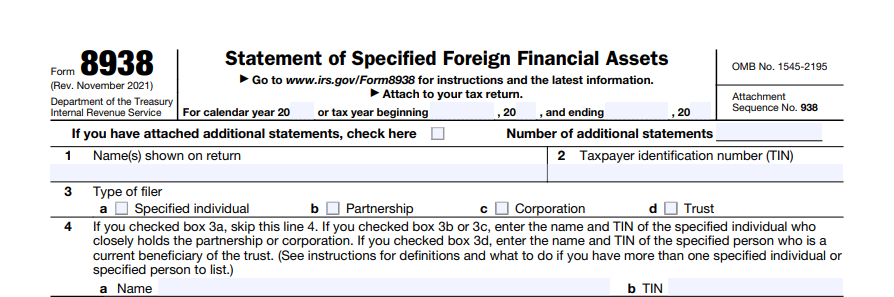
Begin by entering the applicable calendar year or fiscal tax year at the top of Form 8938. Next, complete Lines 1 through 4:
- Line 1: Enter the name shown on your federal tax return.
- Line 2: Enter your taxpayer identification number (TIN).
- Line 3: Identify your filing classification as a specified individual, partnership, corporation, or trust.
- Line 4: If you’re filing as a qualifying domestic entity, enter the requested identifying information for the relevant owner or beneficiary.
If you’re filing as an individual, you can skip Line 4. Check the additional statements box at the top of the form if you’re attaching statements for multiple accounts or assets.
Step 3: Complete Part I, Foreign Deposit and Custodial Accounts Summary

Part I summarizes your reportable foreign bank and investment accounts. You’ll complete Lines 5 through 9 using the information collected from your financial records.
| Line | Information Required |
| 5 | Number of foreign deposit accounts |
| 6 | Combined maximum value of foreign deposit accounts |
| 7 | Number of foreign custodial accounts |
| 8 | Combined maximum value of foreign custodial accounts |
| 9 | Indicate if any reportable accounts were closed during the tax year |
For example, if you maintained two foreign savings accounts and one foreign brokerage account, you would report two deposit accounts on Line 5 and one custodial account on Line 7. You would then enter the applicable combined maximum values on Lines 6 and 8.
Step 4: Complete Part II, Other Foreign Assets Summary

Part II addresses reportable financial assets that aren’t held in foreign deposit or custodial accounts. These may include directly held foreign stocks, partnership interests, and qualifying foreign financial contracts.
Complete the following lines:
- Line 10: Enter the total number of other specified foreign financial assets reported in Part VI.
- Line 11: Enter the combined maximum value of those assets during the tax year.
- Line 12: Indicate if any reportable foreign assets were acquired or sold during the year.
For example, if you directly own shares in two foreign corporations, you may need to report both ownership interests in Part II and provide additional information about each investment in Part VI.
Step 5: Complete Part III, Summary of Tax Items Attributable to Foreign Financial Assets
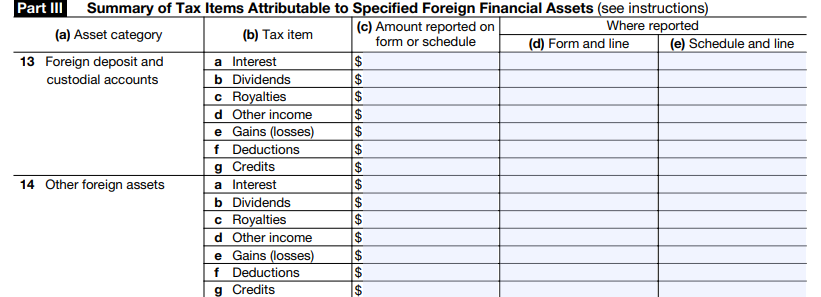
Part III identifies income, deductions, and credits associated with your specified foreign financial assets. You must identify the amounts reported on your federal tax return and indicate where they appear.
The form separates these amounts into two categories:
- Line 13: Tax items attributable to foreign deposit and custodial accounts.
- Line 14: Tax items attributable to other foreign financial assets.
Report applicable interest, dividends, royalties, other income, gains or losses, deductions, and credits. For each category, identify the amount and the corresponding federal tax form or schedule and line. For example, interest earned on a foreign savings account may be reported on Schedule B of Form 1040. Part III identifies that income and its location on your tax return.
Step 6: Complete Part IV, Excepted Specified Foreign Financial Assets

The IRS provides an exception from duplicative reporting for certain assets already disclosed on other international information returns. If the exception applies, you don’t need to repeat the asset information in Parts V or VI of Form 8938, but you must identify the qualifying forms filed.
Part IV requests the number of the following forms submitted:
- Form 3520: Annual Return to Report Transactions With Foreign Trusts and Receipt of Certain Foreign Gifts.
- Form 3520-A: Annual Information Return of Foreign Trust With a U.S. Owner.
- Form 5471: Information Return of U.S. Persons With Respect to Certain Foreign Corporations.
- Form 8621: Information Return by a Shareholder of a Passive Foreign Investment Company or Qualified Electing Fund.
- Form 8865: Return of U.S. Persons With Respect to Certain Foreign Partnerships.
The exception applies to qualifying assets disclosed on these forms. You must still include their values when determining if your aggregate foreign financial assets exceed the Form 8938 reporting threshold.
Step 7: Complete Part V, Detailed Information for Foreign Financial Accounts
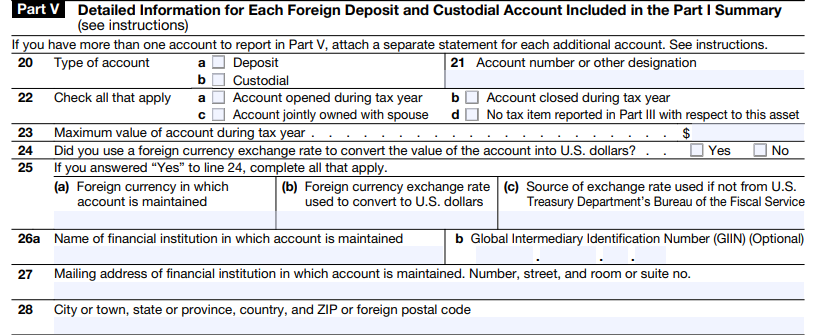
Part V asks for information about each foreign deposit or custodial account included in Part I. Complete Lines 20 through 28 by providing:
- Account classification as deposit or custodial.
- Account number or other identifying designation.
- Account opening or closing information for the tax year.
- Joint ownership information, when applicable.
- Maximum account value during the tax year.
- Foreign currency conversion information.
- Name and mailing address of the foreign financial institution.
- Global Intermediary Identification Number (GIIN), if you choose to provide it.
You must report each qualifying account separately. If you have multiple foreign accounts, attach additional statements containing the required information for each account.
Step 8: Complete Part VI, Detailed Information for Other Foreign Assets
Part VI asks for information about each reportable foreign financial asset included in Part II. Complete Lines 29 through 36 with the following information:
- Asset Description: Identify the foreign investment or financial interest.
- Identifying Information: Provide the asset’s identifying number or designation.
- Acquisition and Disposition Dates: Report applicable dates for assets acquired or disposed of during the tax year.
- Ownership Information: Identify applicable joint ownership with your spouse.
- Maximum Asset Value: Select the appropriate value range, or enter the amount when the maximum value exceeds $200,000.
- Currency Conversion: Provide the foreign currency, exchange rate, and source information.
- Entity Information: Identify the foreign entity if the asset consists of stock or an ownership interest.
- Issuer or Counterparty Information: Provide identifying information for other qualifying financial assets.
Review Parts I through VI to confirm that your account totals, asset values, and identifying information are consistent. Attach the necessary additional statements before submitting Form 8938 with your annual federal tax return.
How and When Do You File Form 8938?
Form 8938 must be submitted with your annual federal tax return by the designated filing deadline, including approved extensions. You don’t file it separately with the IRS, and there’s no independent filing deadline for the form.
How to Submit Form 8938 With Your Federal Tax Return
You must attach Form 8938 to the federal return associated with your filing status or entity classification. Depending on your taxpayer classification, this may include:
- Form 1040: U.S. Individual Income Tax Return.
- Form 1040-NR: U.S. Nonresident Alien Income Tax Return.
- Form 1040-SR: U.S. Tax Return for Seniors.
- Form 1041: U.S. Income Tax Return for Estates and Trusts.
- Form 1065: U.S. Return of Partnership Income.
- Form 1120: U.S. Corporation Income Tax Return.
The IRS also permits Form 8938 to be attached to an amended return when correcting an earlier omission.
Form 8938 Filing Deadlines and Extensions
For most individual taxpayers filing on a calendar-year basis, Form 8938 is due April 15 of the following year. If you receive a valid extension to file your federal income tax return, that extension also applies to Form 8938.
Pro Tip: U.S. citizens and resident aliens living abroad may qualify for an additional two-month filing extension, typically moving their deadline to June 15. They may also request additional filing time under applicable IRS rules.
Get Help With Form 8938 Filing From USA Tax Gurus
Form 8938 reporting requires you to identify qualifying foreign financial assets, calculate their values, and disclose them according to IRS guidelines. Filing errors, omitted accounts, and incorrect asset valuations can result in substantial penalties. If you also meet the FBAR reporting criteria, you must prepare and submit both forms.
At USA Tax Gurus, we help clients meet their international tax reporting obligations. We assist with FATCA compliance, foreign asset disclosures, FBAR filings, and corrections to previously submitted tax returns. Need help filing Form 8938? Book a meeting with us today or call 213-668-6316.
Frequently Asked Questions About Form 8938
Do I Need to File Form 8938 if I Am Not Required to File a U.S. Tax Return?
No. If you’re not required to file a federal income tax return for the year, you generally don’t need to file Form 8938, even if your foreign financial assets exceed the applicable reporting threshold. However, you may still have separate FBAR or other international reporting obligations.
Do I Need to File Form 8938 if My Foreign Assets Didn’t Generate Any Income?
Yes, you may still need to file Form 8938 even if your foreign financial assets did not generate interest, dividends, or other income during the year. The reporting requirement is generally based on the value of your specified foreign financial assets, not whether they generated taxable income. You must also meet the applicable taxpayer and income tax return filing requirements.
Do I Need to File Both Form 8938 and FBAR?
Yes, you must file both forms if your foreign financial holdings meet the reporting standards for each.
For example, let’s assume you’re unmarried, live in the United States, and maintain foreign bank accounts with a combined maximum value of $90,000 during the calendar year. If you’re required to file a federal income tax return, these holdings exceed both the Form 8938 threshold (more than $75,000 at any time during the year) and the FBAR threshold (an aggregate value of more than $10,000 at any time during the year). You must submit both reports.
The filing procedures are also different. Form 8938 accompanies your federal income tax return, while the FBAR must be submitted separately through FinCEN’s BSA E-Filing System. The FBAR receives an extension to October 15 without requiring a formal extension request.
What Happens If I Fail to File Form 8938?
Failing to file Form 8938 or submitting incomplete or inaccurate information can result in substantial IRS penalties. They include:
- Initial Failure-to-File Penalty: If you don’t submit a complete and accurate Form 8938 by the applicable deadline, the IRS may assess a $10,000 penalty.
- Continued Noncompliance: If you fail to correct the violation within 90 days after the IRS mails you a notice, additional penalties of $10,000 apply for each subsequent 30-day period or portion of a period. These additional penalties are capped at $50,000, bringing the combined failure-to-file penalties to $60,000.
- Accuracy-Related Penalty: If you underpay federal income tax because of a transaction involving an undisclosed foreign financial asset, the IRS may impose a penalty equal to 40% of the resulting tax underpayment.
- Fraud Penalties: If an underpayment results from tax fraud, a penalty equal to 75% of the fraudulent underpayment may apply. Criminal penalties may also apply to qualifying violations.
For example, if you fail to disclose foreign corporate shares and omit $20,000 in taxable dividends from your federal income tax return, you may face penalties for both the missing Form 8938 disclosure and the resulting tax underpayment.
Normally, the IRS has three years after you file your return to assess additional tax. If you’re required to file Form 8938 and don’t, the assessment period for your entire tax return stays open until three years after you provide the missing information. Separately, if you omit more than $5,000 of income attributable to specified foreign financial assets, the assessment period extends to six years.
Penalties can be waived if you can demonstrate that you acted with reasonable cause and in good faith. The IRS determines reasonable cause on a case-by-case basis and analyzes all the facts and circumstances surrounding your situation before making a decision on penalty relief.