

Key Takeaways:
- Small-business payroll services commonly start around $17-$50 per month, plus approximately $4-$7 per employee, although actual costs vary based on employee count, payroll frequency, locations, and the level of service provided.
- Payroll companies may charge a monthly base fee plus a per-employee fee, a fee for each payroll run, tiered package pricing, or a custom/flat monthly rate. Businesses should compare total annual costs rather than advertised starting prices.
- Employee count, payroll frequency, multistate employees, variable compensation, benefits, and HR or time-tracking services can all increase payroll costs. Additional fees may also apply for setup, year-end tax forms, off-cycle payrolls, and additional state or local filings.
- Payroll packages typically handle wage calculations, employee payments, tax withholding, payroll tax deposits and filings, and year-end reporting, but what’s included varies significantly by provider and service tier.
- Outsourcing payroll can become more cost-effective when payroll consumes significant staff time, a business grows or hires across multiple states, or errors require frequent corrections. Businesses should compare the full cost of software and internal labor against the annual cost of outsourced payroll, not just the provider’s monthly fee.
Once you hire employees, payroll becomes a recurring business expense. You need to calculate gross pay, withhold federal and applicable state and local taxes, account for deductions, issue payments, maintain payroll records, and complete required tax filings. If you hire a payroll provider to handle this work, you’ll also need to account for service fees in your operating budget.
So, how much should you expect to pay? Many online payroll services charge a monthly base fee plus a separate fee for each employee. Your actual expense depends on your workforce size, pay frequency, employee locations, and the level of payroll assistance you purchase.
At USA Tax Gurus, we provide payroll services as part of our business accounting services. Our payroll assistance can work alongside bookkeeping and tax services, giving you access to professionals who already work with business financial records and tax filings. In this guide, we explain how payroll service pricing works, which charges can increase your bill, what payroll packages typically include, and how to compare outsourcing with handling payroll internally.
USA Tax Gurus is a team of enrolled agents and licensed CPAs who can help you take control of your business finances to maximize profits, reduce taxes, and provide increased financial clarity. We’re QuickBooks Pro Advisors, but our tech-savvy team can work in almost any accounting platform, including Wave, Zoho, and more. Schedule your free consultation today with a member of our team to learn more!
How Much Do Payroll Services Cost for a Small Business?
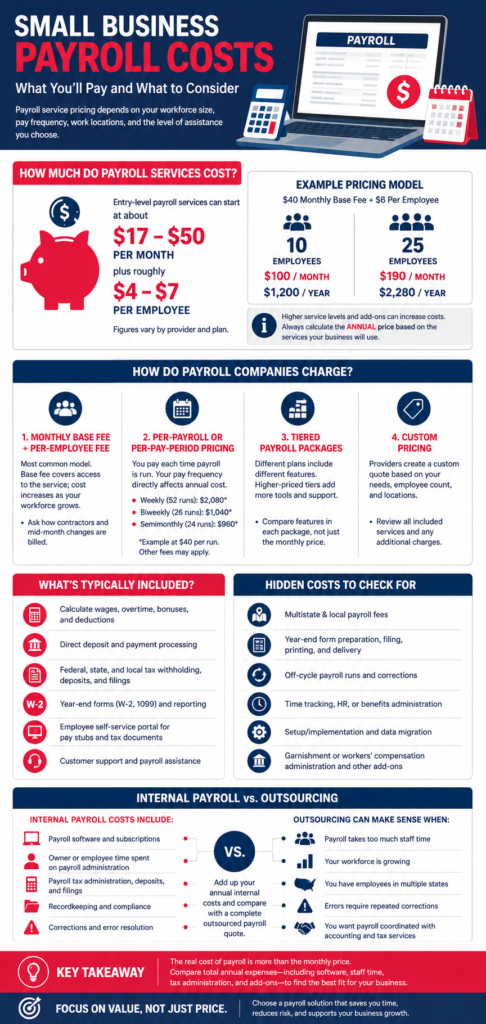
Payroll service costs vary according to the type of service you purchase, the number of people you pay, and the payroll tasks included in your plan. Entry-level small-business payroll software can start at about $17 to $50 per month, plus roughly $4 to $7 per employee. These figures provide a useful starting point for budgeting, but they aren’t a fixed industry average.
A common pricing model combines a monthly base charge with a per-employee fee. For example, suppose your provider charges $40 per month plus $6 for each employee. A business with 10 employees would pay $100 per month, or $1,200 per year. At 25 employees, the same plan would cost $190 per month, or $2,280 annually. Your payroll expense therefore rises as you add employees, even when the base fee stays the same.
Higher service levels can increase those figures. Payroll tax payments and filings, time tracking, HR administration, benefits administration, multistate payroll, and added support may be included in higher-priced plans or charged separately. Some providers also use custom pricing rather than publishing a standard monthly rate.
You should calculate the annual price based on the services your business will use rather than comparing base fees. A provider with a lower monthly starting price can become more expensive after per-employee fees and additional charges are included.
Pro Tip: If a lower-priced service leaves your staff responsible for entering payroll information, reviewing records, handling tax-related tasks, correcting errors, and answering employee questions, those working hours have a financial cost. Comparing that expense with the price of outsourced assistance gives you a better picture of what payroll administration costs your business.
How Do Payroll Companies Charge Small Businesses?
Payroll companies use several different pricing methods. Before comparing quotes, identify how each provider calculates its charges and which payroll tasks are included in that price.
Monthly Base Fee Plus a Per-Employee Fee
One of the most common pricing methods combines a monthly base fee with a charge for each employee. The base fee pays for access to the payroll service, while the employee charge increases according to the size of your workforce.
For example, a service priced at $40 per month plus $5 per employee would cost $65 per month for five employees. If your workforce grows to 20 employees, the monthly charge increases to $140. This model makes employee count an important part of your annual payroll budget.
When reviewing this type of plan, check how the provider treats workers who join or leave during the month. You should also find out if contractors generate the same per-person charge as employees.
Per-Payroll or Per-Pay-Period Pricing
Some payroll companies charge each time they run payroll rather than using one monthly fee. Under this model, your pay schedule can have a direct effect on annual service costs.
A company running payroll weekly has 52 regular pay periods in a year, while a biweekly schedule generally has 26. Semimonthly payroll has 24 regular pay periods. If your provider charges $40 for each payroll run, those schedules would produce annual base charges of $2,080, $1,040, and $960, respectively, before employee charges or other fees.
Off-cycle payroll can add another expense. You may need an additional run to correct a payment, issue a bonus, or pay an employee outside the regular schedule. Ask how these runs are billed before signing a service agreement.
Tiered Payroll Packages
Payroll companies may divide their services into several plans, with the monthly price increasing as more features are added. An entry-level package may include wage calculations, direct deposit, employee access to pay information, and payroll tax administration. Higher-priced plans may add time tracking, HR tools, employee onboarding, benefits administration, reporting, or additional support.
Tiered pricing requires you to compare the services within each package rather than choosing according to the monthly price. Paying for a higher tier makes little financial sense if your business won’t use its added features. A lower tier can also become less economical if you have to purchase several add-ons separately.
Flat-Fee and Custom Pricing
Accounting firms and managed payroll providers may charge a flat monthly fee or prepare an individual quote based on your business. The provider may consider your employee count, payroll frequency, employee locations, compensation methods, tax filing obligations, and requested services when calculating the price.
Custom pricing can make direct comparisons harder because there isn’t always a published rate to use as a benchmark. Ask for a written quote that identifies recurring fees, setup charges, per-employee costs, and services billed separately. You can then calculate what you’ll pay over a full year and compare each proposal using the same criteria.
What Determines the Cost of Payroll Services?
The number of employees you have is a major factor in payroll pricing, but it isn’t the only one. Pay frequency, employee locations, compensation methods, benefits, and added administrative services can change what you pay. Reviewing these factors before requesting quotes can help you estimate your annual payroll service expense.
Number of Employees
Many payroll providers charge a fee for each employee in addition to a monthly base price. As your workforce grows, your monthly bill rises with it.
Suppose your plan costs $40 per month plus $6 per employee. You’d pay $70 per month with five employees, $100 with 10, and $190 with 25. If you’re planning to hire, calculate what the service will cost at your projected employee count rather than basing your budget on your current workforce.
Payroll Frequency
Your pay schedule can affect your service fees when a provider charges for each payroll run. A weekly schedule produces 52 regular payroll runs per year, compared with 26 for a biweekly schedule and 24 for a semimonthly schedule.
The difference is less important when your plan includes unlimited payroll runs for one monthly fee. Before comparing prices, determine if regular and off-cycle payroll runs are included or billed separately.
Number of States Where Employees Work
Employing people in multiple states can increase payroll administration. An employer may have withholding, unemployment tax, registration, and reporting duties in states where employees work. Those duties can lead to additional provider fees for multistate payroll administration.
Remote hiring makes this issue particularly relevant. If an employee begins working from another state, your payroll obligations may change even though your company’s primary location hasn’t. You should tell your payroll provider where each employee works and ask how adding another state will affect your fees.
Employee Compensation
A workforce receiving the same salaries each pay period can require less recurring data entry than one with changing hours and compensation. Hourly wages, overtime, commissions, bonuses, tips, shift differentials, and paid leave can increase the amount of payroll information that needs to be collected and reviewed.
These differences don’t mean a provider will always charge extra for variable compensation. They do mean you should verify which calculations your plan includes before comparing prices.
Employees and Independent Contractors
Your worker mix can affect your payroll service bill because providers may charge separate per-person fees for employees and independent contractors. Year-end reporting also differs. Employees generally receive Form W-2, while payments to qualifying independent contractors are generally reported on Form 1099-NEC.
Worker classification isn’t a pricing choice. The IRS uses the working relationship between the business and worker to determine employee or independent contractor status. You shouldn’t classify someone as an independent contractor simply because contractor payroll services cost less.
Benefits and Retirement Contributions
Health insurance, retirement contributions, and other employee benefits can add payroll deductions and employer contributions that need to be recorded correctly. Some payroll packages include benefits administration, while others place it in a higher-priced plan or charge an additional fee. If you provide benefits, determine which deductions and contributions the provider handles and how those services affect your monthly price.
Time Tracking and HR Services
Businesses with hourly employees may use time-tracking software to send recorded hours directly to payroll. Employee onboarding, paid time off administration, benefits administration, and other HR services may also be available through the same provider.
These features can reduce manual administrative work, but they can increase your subscription price. Compare the cost of adding them to your payroll plan with what you’re already spending on separate software and staff time. That comparison can tell you which arrangement makes financial sense for your business.
What Is Typically Included in Payroll Service Packages?
The services included in a payroll package vary by provider and service level. Before comparing prices, you need to know which payroll duties the quoted fee pays for. A plan that costs less but leaves several recurring tasks with your staff may produce a different financial result than a service that handles those duties for you.
Payroll Calculations
Payroll services generally calculate employee pay for each pay period. Depending on your workforce, those calculations may account for regular wages, hourly pay, overtime, bonuses, commissions, paid leave, and payroll deductions.
The provider uses employee and payroll data supplied by your business to calculate gross pay and deductions before determining net pay. If your employees’ hours or compensation change from one pay period to another, you’ll need a reliable method for submitting that information before payroll is run.
Employee Payments
Direct deposit is a standard feature of many payroll packages. Some providers also support paper checks or other payment methods.
Your employees generally receive pay statements showing gross wages, deductions, taxes withheld, and net pay. Employee self-service portals may give workers access to pay statements, tax documents, direct deposit information, and other payroll records without requiring them to request each document from you.
Payroll Tax Withholding
Federal law requires employers to withhold applicable federal income tax, Social Security tax, and Medicare tax from employee wages. Employers also pay their share of Social Security and Medicare taxes. State and local withholding requirements may apply based on where your employees work and other applicable rules.
Payroll services can calculate these amounts as part of each payroll run. USA Tax Gurus provides federal, state, and local tax withholding assistance as part of our business payroll support.
Payroll Tax Deposits and Filings
Full-service payroll assistance can extend beyond calculating the taxes you owe. A provider may deposit payroll taxes and prepare required federal, state, and local filings on your behalf.
Form 941 is one of the recurring federal filings that applies to many employers. It reports items such as wages paid, federal income tax withheld, and the employee and employer shares of Social Security and Medicare taxes. It is generally filed quarterly by employers that pay wages subject to these taxes, although different filing rules apply to some employers.
Year-End Payroll Reporting
Year-end reporting is another service to check when evaluating a payroll package. Depending on the provider and plan, payroll assistance may include preparing employee Forms W-2 and applicable information returns for contractors. Ask if year-end forms are included in your regular fee or billed separately. A low monthly rate becomes less attractive if you’re charged additional fees for each year-end form.
USA Tax Gurus includes quarterly and annual payroll reporting among our payroll services. The firm also provides payroll setup, tax withholding, payroll report filing, and assistance obtaining payroll and state tax identification numbers.
Time and Attendance Integration
If you have hourly employees, connecting timekeeping with payroll can reduce duplicate data entry. Hours, overtime, and leave records can pass from the timekeeping system into payroll rather than requiring your staff to enter the same information twice. If your business uses this type of integration, ask if it is included in your quoted payroll fee or carries an additional charge.
Which Payroll Costs May Not Be Included in the Advertised Price?
The monthly price displayed by a payroll provider may represent only part of what you’ll pay. Some companies bundle payroll runs, tax filings, year-end forms, and other services into their regular fee, while others charge separately for them. Before choosing a provider, request an itemized quote so you can calculate your annual expense.
Setup and Implementation Fees
Starting payroll with a new provider can involve entering employee records, tax information, year-to-date wages, deductions, direct deposit instructions, and other payroll data. Some providers include setup in the subscription price, while others charge an implementation fee.
This expense is especially important when you’re switching providers during the year because existing payroll records need to transfer to the new system. Ask about implementation charges before comparing the first-year cost of competing services.
Multistate and Local Payroll Fees
If you have employees working in several states, your provider may charge for payroll tax administration in each additional state. Some services include one state in their standard price and assess a monthly fee for additional states. Local tax administration can carry another charge.
A growing business should consider these fees before hiring remote employees or expanding into another state. A payroll plan that fits your current budget can become more expensive as your geographic reach increases.
Year-End Forms
Don’t assume Forms W-2 and 1099-NEC are included in the advertised monthly fee. Some payroll services include preparation and filing, while others charge for year-end forms. Per-form charges can add up as your workforce grows. If you have 30 employees, for example, even a modest charge for each W-2 creates an additional year-end expense. Ask about preparation, electronic filing, printing, and delivery when reviewing your quote.
Off-Cycle Payroll and Corrections
You may occasionally need to issue a payment outside your regular payroll schedule. Bonuses, corrections, final paychecks, and other payments can require an off-cycle payroll run. Some plans include unlimited payroll runs, including off-cycle payments. Others assess a separate fee each time you run payroll outside your regular schedule. If your compensation practices result in additional runs during the year, find out how your provider bills for them.
Additional Payroll and HR Services
Your base payroll package may exclude services that your business needs. Depending on the provider, additional charges can apply to time tracking, benefits administration, garnishment administration, workers’ compensation administration, HR tools, accounting integrations, and additional business entities.
Before signing an agreement, ask the provider to identify every recurring fee and one-time charge associated with your account. Calculate the annual total using your current employee count, payroll schedule, work locations, year-end reporting needs, and add-on services. That figure gives you a stronger basis for comparing payroll providers than the advertised monthly rate.
Is It Cheaper to Run Payroll Yourself or Outsource It?
Running payroll internally may cost less for a small business with a few employees, consistent pay periods, and staff who already have the knowledge and time to handle payroll administration. As your workforce grows, however, the hours devoted to payroll can increase along with your software and administrative expenses.
Consider a business with five salaried employees who work in one state and receive the same compensation each pay period. Payroll may require limited changes from one pay date to the next. If the owner or an existing employee can administer it without spending substantial working hours on the task, keeping payroll internal may cost less.
The calculation can change as you hire hourly employees, add commissions or bonuses, expand into other states, or devote additional staff hours to payroll. At that point, you need to compare the annual price of outsourcing with what you’re spending on software and employee time.
Outsourcing also changes who performs recurring payroll duties. A payroll service provider can prepare employee payments, employment tax returns, federal tax deposits, and Forms W-2 when those services are included in the arrangement. The IRS recognizes these functions as duties a payroll service provider can perform on an employer’s behalf.
You still need to oversee your federal employment tax obligations. In a standard payroll service provider arrangement, hiring a third party generally doesn’t remove your responsibility for required federal tax payments and filings. The IRS recommends that employers monitor tax deposits through the Electronic Federal Tax Payment System (EFTPS).
The better financial choice depends on the total annual expense of each approach. If internal payroll costs $2,000 in software and $4,000 in employee time, you’re spending $6,000 before accounting for corrections and other administrative expenses. An outsourced service costing $4,500 annually would reduce that expense by $1,500. If the same business spends only $2,500 per year administering payroll internally, outsourcing at $4,500 would increase its direct annual expense.
You should put actual numbers behind the comparison. Calculate what you spend on software, staff hours, payroll administration, and corrections, then compare that amount with a complete annual quote for outsourced payroll. The result will tell you which option costs less for your business.
When Does It Make Sense to Outsource Payroll?
Outsourcing payroll can make sense when administering it internally consumes staff hours, your workforce expands, or your payroll obligations become harder to manage with existing resources. You don’t need to reach a set number of employees before outsourcing becomes appropriate. The decision depends on how much work payroll creates and what your business spends to handle it internally.
Payroll Is Taking Too Much Staff Time
Payroll creates recurring work every pay period. Someone needs to collect employee information, review hours and compensation, enter changes, check deductions, approve payments, maintain records, and address employee questions.
Track how many hours you or your employees spend on these duties during a typical month. If payroll repeatedly takes staff away from accounting, customer service, sales, management, or other business responsibilities, compare the value of those hours with the price of outsourcing.
Your Business Is Hiring More Employees
Adding employees increases the amount of payroll information your business needs to maintain. New hires bring wage information, tax withholding forms, payment instructions, benefits deductions, and other records that need to be incorporated into payroll.
Growth can also make manual methods harder to maintain. A system that worked for five employees may require considerably more administrative time when you’re paying 20 or 50 people. Outsourcing gives you another option when your existing payroll method no longer fits your workforce.
You Have Employees Working in Multiple States
Hiring employees in other states can add state registration, withholding, unemployment tax, and reporting duties. The requirements depend on where your employees work and the tax rules that apply there.
This issue can arise when you intentionally expand into another state or hire remote employees. If your business doesn’t have staff with experience administering multistate payroll, outside assistance can handle many of the recurring calculations, filings, and payments associated with those employees.
Payroll Errors Are Requiring Repeated Corrections
Incorrect hours, missed deductions, inaccurate withholding information, late tax deposits, and payment errors can consume staff time. They can also lead to amended records or tax filings. If your employees regularly spend time finding and correcting payroll errors, compare that expense with the price of professional payroll assistance.
You Want Payroll and Tax Services Handled Together
Payroll records feed directly into business accounting and tax reporting. Wages, employer payroll taxes, benefits, and other employment expenses need to appear correctly in your financial records.
Working with a firm that provides payroll, bookkeeping, and tax services can reduce the amount of information you need to transfer between separate providers. At USA Tax Gurus, we provide payroll services alongside bookkeeping, accounting, and business tax assistance. This arrangement can be useful when you want the professionals handling your payroll to work with the same financial information used for your accounting and tax filings.
You Need Assistance Beyond Payroll Software
Payroll software and outsourced payroll assistance aren’t the same service. Software can automate calculations and provide tools for administering payroll, but someone at your business may still need to enter information, review results, approve transactions, maintain employee records, and oversee tax obligations.
Outsourcing shifts many recurring payroll duties to an outside provider. Payroll service providers can administer payroll and employment taxes, report payroll information, and deposit employment taxes with federal and state authorities when those duties are included in the agreement.
You still retain oversight responsibilities. The IRS states that employers generally remain responsible for federal employment taxes when they use a third-party payroll provider. Outsourcing therefore works best as a way to reduce internal administration while you continue monitoring your business’s payroll and tax records.
Discuss Your Payroll Needs With USA Tax Gurus
Choosing a payroll provider isn’t only a question of price. You also need to determine which recurring tasks you’re paying the provider to handle and how those services fit with your bookkeeping and tax needs. At USA Tax Gurus, our payroll services start at $299 and can handle payroll administration from initial setup through recurring payments and tax reporting.
We can set up your payroll account, establish direct deposit, calculate employee wages, account for overtime and bonuses, apply benefit deductions, and administer federal, state, and local tax withholding. We also prepare payroll reports and quarterly and annual tax filings, including applicable Forms W-2 and 1099. If you need payroll or state tax identification numbers, we can assist with those registrations as part of our payroll services. Book a meeting with us today or call 213-668-6316 and see how we can help.
FAQs About the Average Cost of Payroll Services For Small Businesses
Do Payroll Companies Charge Every Time You Run Payroll?
It depends on the provider’s pricing method. Some payroll plans include unlimited payroll runs for a monthly fee, while other providers charge each time payroll is processed. This distinction can have a large impact on your annual expense. A company that pays employees weekly runs 52 regular payrolls each year, compared with 26 for a biweekly schedule and 24 for a semimonthly schedule. You should also ask how the provider charges for off-cycle payroll used for bonuses, corrections, or other payments outside your normal schedule.
Are Payroll Tax Filings Included in Payroll Service Fees?
Payroll tax filings may be included in your regular service fee or charged separately, depending on the provider and plan you select. A payroll service provider can prepare and file federal employment tax returns and make federal tax deposits when authorized to perform those duties. Before choosing a service, confirm which federal, state, and local filings are included and ask about additional charges for multiple states or year-end reporting.
Does Outsourcing Payroll Transfer Tax Responsibility to the Payroll Company?
Generally, no. The IRS states that employers remain responsible for federal employment tax obligations when using a standard payroll service provider. If the provider fails to make a required federal tax payment, the employer can remain liable for the taxes, penalties, and interest.
The IRS recommends that employers retain their own address as the address of record and use the Electronic Federal Tax Payment System to monitor deposits made under their EIN. Different liability rules can apply to other third-party payer arrangements, including Certified Professional Employer Organizations.