

Key Takeaways:
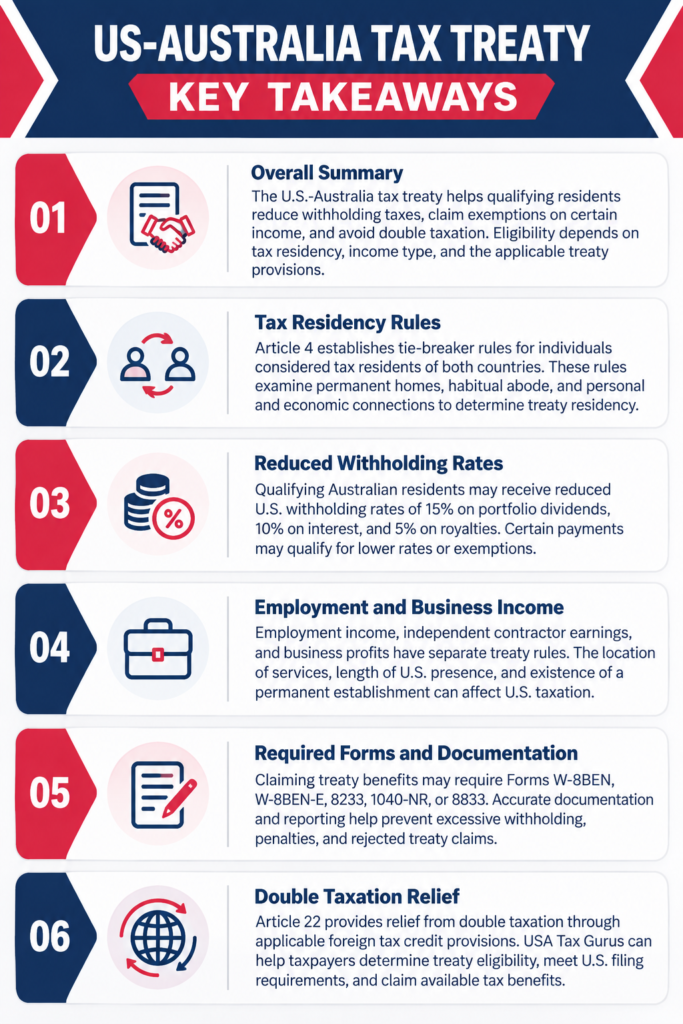
- The U.S.-Australia tax treaty helps qualifying residents reduce withholding taxes, claim exemptions on certain income, and avoid double taxation. Eligibility depends on tax residency, income type, and the applicable treaty provisions.
- Article 4 establishes tie-breaker rules for individuals considered tax residents of both countries. These rules examine permanent homes, habitual abode, and personal and economic connections to determine treaty residency.
- Qualifying Australian residents may receive reduced U.S. withholding rates of 15% on portfolio dividends, 10% on interest, and 5% on royalties. Certain payments may qualify for lower rates or exemptions.
- Employment income, independent contractor earnings, and business profits have separate treaty rules. The location of services, length of U.S. presence, and existence of a permanent establishment can affect U.S. taxation.
- Claiming treaty benefits may require Forms W-8BEN, W-8BEN-E, 8233, 1040-NR, or 8833. Accurate documentation and reporting help prevent excessive withholding, penalties, and rejected treaty claims.
- Article 22 provides relief from double taxation through applicable foreign tax credit provisions. USA Tax Gurus can help taxpayers determine treaty eligibility, meet U.S. filing requirements, and claim available tax benefits.
If you’re an Australian resident earning income from U.S. investments, employment, or business activities, you may have tax obligations in both countries. This is because:
- The United States taxes certain income earned by foreign individuals and businesses
- Australia taxes its residents on income from Australian and foreign sources
Without appropriate relief, the same earnings may be subject to taxation in both countries. The U.S.-Australia tax treaty addresses this issue by establishing rules for taxing cross-border income.
At USA Tax Gurus, we help nonresident taxpayers determine how U.S. tax rules and international treaties apply to their income. This guide explains who qualifies for treaty benefits, how different income categories are taxed, which withholding rates apply, and what documentation you’ll need to claim available tax relief.
USA Tax Gurus is a team of enrolled agents and licensed CPAs who can help you take control of your business finances to maximize profits, reduce taxes, and provide increased financial clarity. We’re QuickBooks Pro Advisors, but our tech-savvy team can work in almost any accounting platform, including Wave, Zoho, and more. Schedule your free consultation today with a member of our team to learn more!
What Is the U.S.-Australia Tax Treaty?
The U.S.-Australia tax treaty is a bilateral agreement that establishes how certain income earned across both countries is taxed. Officially called the Convention for the Avoidance of Double Taxation and the Prevention of Fiscal Evasion with Respect to Taxes on Income, it was signed in Sydney on August 6, 1982 and took effect October 31, 1983. A protocol signed in 2001 amended several provisions, including the withholding tax rates for dividends, interest, and royalties. The protocol entered into force when ratification instruments were exchanged on May 12, 2003.
The treaty addresses several aspects of cross-border taxation:
- Preventing Double Taxation: The agreement provides rules for reducing double taxation when both countries have the right to tax the same income.
- Reducing Withholding Taxes: Qualifying taxpayers can claim lower tax rates on certain dividends, interest payments, and royalties received from the other country.
- Determining Tax Residency: The treaty establishes rules for resolving residency questions when an individual qualifies as a tax resident of both countries.
- Allocating Taxing Rights: Different provisions determine how income from employment, business activities, investments, real estate, and retirement payments may be taxed.
- Resolving Tax Disputes: Taxpayers can request assistance from the appropriate tax authorities when they believe taxation by either country violates the treaty.
Note: The agreement applies mainly to U.S. federal income taxes and certain Australian taxes, including Australian income tax on capital gains. It doesn’t replace domestic tax legislation or remove every tax obligation. You must meet treaty conditions before claiming any tax relief.
Who Can Claim Benefits Under the U.S.-Australia Tax Treaty?
The U.S.-Australia tax treaty applies to people and businesses that qualify as tax residents of one or both countries under Article 4. To claim a benefit, you must also meet the conditions for the income you’re receiving.
Australian Tax Residents With U.S.-Source Income
If you’re an Australian tax resident earning income from U.S. sources, you may qualify for reduced withholding rates or exemptions under the treaty. The treatment depends on the income category and how it was earned.
Examples include:
- Investment Income: Dividends from U.S. companies and certain interest payments may qualify for reduced withholding rates.
- Employment Income: Australian residents temporarily working in the United States may qualify for exemptions if they meet the treaty’s employment conditions.
- Independent Contractor Income: Freelancers and consultants performing services in the United States may qualify for relief based on their length of stay and business presence.
- Business Profits: Australian companies conducting business with U.S. customers may receive treaty protection when they don’t have a U.S. permanent establishment.
Your work location is especially important. For example, an Australian consultant working entirely from Australia for an American company has different U.S. tax considerations than one who travels to California to perform the same services.
U.S. Nonresident Aliens and Treaty Eligibility
For federal income tax purposes, the IRS typically classifies foreign individuals as resident or nonresident aliens. The two main tests for U.S. tax residency are:
- Green Card Test: You’re a U.S. tax resident if you meet the lawful permanent resident requirements during the calendar year, subject to exceptions.
- Substantial Presence Test: You may qualify as a U.S. tax resident based on your physical presence during the current calendar year and the two preceding years.
If you don’t meet either test, you’re usually a nonresident alien. However, those who meet a U.S. residency test may qualify as Australian residents under the treaty’s dual-residency provisions, which can change their U.S. income tax treatment.
Treaty Benefits for Australian Companies
Australian corporations may claim treaty benefits on eligible U.S.-source income, but Article 16 includes limitation-on-benefits rules intended to prevent treaty abuse. Specifically, a company must satisfy an eligibility test involving factors such as ownership, publicly traded status, or active business operations. Companies that fail these tests may be unable to claim reduced withholding rates or other treaty benefits, even when they’re Australian tax residents.
How Does the US-Australia Tax Treaty Determine Tax Residency?
When you’re considered a tax resident of both the United States and Australia, Article 4 of the treaty has rules for determining which country will be treated as your residence for treaty purposes. These rules are known as tie-breaker provisions. They examine your living arrangements and connections to each country rather than relying solely on the number of days you’ve spent there.
How Do the Treaty’s Tie-Breaker Rules Work?
Article 4 establishes three tests that apply in the following order:
- Permanent Home: The first consideration is where you maintain a permanent home. A home may be owned or rented, but it must be available for your ongoing use. If you maintain a permanent home in only one country, that country is treated as your treaty residence.
- Habitual Abode: If you maintain permanent homes in both countries or neither country, the next consideration is where you habitually live. This involves examining your pattern of residence rather than relying on a single visit or temporary assignment.
- Personal and Economic Relations: If you have a habitual abode in both countries or neither, the treaty considers where your personal and economic connections are closer. Relevant factors include family relationships, employment, business interests, and citizenship.
If these tests don’t establish a single country of residence, the U.S. and Australian tax authorities can attempt to resolve the issue through the mutual agreement procedure under Article 24.
Example of Dual Residency Under the Treaty
Suppose you’re an Australian citizen who owns a home in Melbourne, where your spouse and children live. You also rent an apartment in New York while working for an American employer. Both homes remain available to you throughout the year.
Although you have a home in each country, Article 4 directs that the place where you live with your family be considered when identifying your permanent home. Because your family lives in Melbourne, this factor points toward Australia as your treaty residence at the first tie-breaker step.
The analysis changes if your family moves to New York with you while you keep the Melbourne home. In that case, the permanent home test may not resolve your residency, and the next consideration is where you habitually live. If you habitually live in both countries or in neither, your personal and economic relations decide the outcome, and the treaty specifically requires your citizenship to be taken into account at that stage. If the tests still don’t produce an answer, the U.S. and Australian tax authorities can determine your residency through the mutual agreement procedure.
The outcome determines which country is treated as your residence when applying the treaty’s income tax provisions. Depending on your situation, you may still have U.S. filing obligations even if you’re treated as an Australian resident under the treaty. For example, claiming treaty residency to override U.S. residency rules generally requires disclosure on Form 8833.
What Are the Main Benefits of the U.S.-Australia Tax Treaty?
The U.S.-Australia tax treaty can limit the amount of tax one country may impose when you’re a resident of the other. It also establishes conditions under which income may be taxed exclusively in your country of residence. The benefits depend on the treaty article in question and the tax treatment of your earnings.
Reduced Withholding Taxes
The United States imposes a standard 30% withholding tax on many types of U.S.-source income paid to foreign individuals and businesses. Under the treaty, qualifying Australian residents can claim lower rates on dividends, interest, and royalties.
For example, an Australian investor receiving dividends from a U.S. corporation may qualify for a 15% withholding rate instead of 30%. Different rates apply to certain corporate shareholders, interest payments, and royalties. We’ll examine these distinctions in the income-specific sections below.
Relief From Double Taxation
Article 22 addresses relief from double taxation when the United States and Australia both have taxing rights over the same income. Australian residents may qualify for a foreign income tax offset against Australian tax for eligible U.S. taxes paid. U.S. taxpayers may also qualify for foreign tax credits under the applicable treaty and domestic tax provisions.
Exemptions From Certain U.S. Income Taxes
Some treaty provisions assign exclusive taxing rights to the taxpayer’s country of residence. This can exempt qualifying income from U.S. federal income tax even when the taxpayer has financial or business activities in the United States.
For example, an Australian company earning profits from U.S. business activities may qualify for an exemption if it doesn’t conduct those activities through a U.S. permanent establishment. Certain employment earnings and independent personal services may also receive favorable treatment under their respective treaty articles.
What Types of Income Are Affected by the U.S.-Australia Tax Treaty?
The U.S.-Australia tax treaty contains separate provisions for investment income, wages, business profits, property transactions, and retirement payments. Identifying the correct category is necessary because income from different sources can receive different treatment, even when it’s paid to the same taxpayer.
Dividends From U.S. Companies
Article 10 governs dividends paid by companies in one treaty country to residents of the other. If you’re an Australian resident receiving dividends from U.S. stocks, the treaty may reduce the federal withholding tax deducted before you receive payment.
The rates include:
- 15% for Portfolio Dividends: Australian individuals holding shares in U.S. corporations can typically qualify for a 15% withholding rate instead of the standard 30%.
- 5% for Certain Corporate Shareholders: An eligible Australian company holding at least 10% of the voting power in a U.S. corporation may qualify for the reduced rate.
- 0% for Certain Corporate Shareholders: Qualifying Australian companies with substantial ownership interests in U.S. corporations may receive dividends without U.S. withholding tax, provided they meet the treaty’s ownership, holding-period, and eligibility requirements.
For example, suppose you receive $20,000 in annual dividends from American stocks. At the standard 30% withholding rate, $6,000 would be deducted. If you qualify for the 15% treaty rate, withholding drops to $3,000, leaving an additional $3,000 available to you.
Interest Income
Article 11 establishes a maximum 10% withholding rate on qualifying interest paid between the two countries. Certain interest payments to eligible financial institutions and government bodies may qualify for a complete exemption under the treaty.
However, U.S. domestic tax law already exempts some interest received by nonresident aliens. Examples include qualifying portfolio interest on certain debt obligations and interest paid on eligible U.S. bank deposits. If a domestic exemption applies, you may receive the payment without U.S. income tax withholding rather than paying the treaty’s 10% rate.
Royalties and Intellectual Property Income
Article 12 addresses income from licensing intellectual property and certain other rights. Under the treaty as amended, qualifying royalties paid by a U.S. source to an Australian resident are subject to a maximum 5% U.S. withholding tax.
Payments that may fall within the treaty’s royalty provisions include:
- Licensing fees for patents and trademarks.
- Payments for the use of certain copyrights.
- Compensation for using qualifying intellectual property rights.
For example, an Australian software business licensing qualifying intellectual property to a U.S. company may receive royalty payments subject to 5% withholding instead of 30%. However, payments for software, services, and intellectual property transfers must be classified under the appropriate tax rules before the treaty rate can be applied.
The leasing of industrial, commercial, or scientific equipment was at one point within the royalty provisions, but is no longer included. Equipment leasing is now handled under business profits instead.
Employment Income Earned in the United States
Article 15 addresses wages and other compensation received by employees working across the two countries. If you’re an Australian resident temporarily working in the United States, your employment income may be exempt from U.S. federal income tax when all three conditions are satisfied:
- You’re present in the United States for no longer than 183 days during the given U.S. tax year.
- Your compensation is paid by, or on behalf of, an employer that isn’t a U.S. resident.
- Your compensation isn’t deductible in calculating the taxable income of your employer’s U.S. trade or business.
Consider an Australian employee sent to Texas for a four-month assignment. The employee remains on an Australian company’s payroll, and the compensation isn’t deductible against the employer’s U.S. taxable business income. If the employee meets the treaty’s other requirements, the wages earned during that assignment may be exempt from U.S. federal income tax. However, if the employee works directly for a U.S. employer, the exemption may be unavailable even when the assignment lasts fewer than 183 days.
The income tax treaty doesn’t cover U.S. Social Security and Medicare (FICA) taxes. These are handled under a separate U.S.-Australia totalization agreement, which can prevent workers on temporary assignments from contributing to both countries’ systems. Coverage under the agreement is usually documented with a certificate of coverage obtained before or during the assignment.
Self-Employment and Independent Contractor Income
Article 14 addresses income from independent personal services, including certain consulting, professional, and freelance activities. Australian residents performing these services in the United States may qualify for an exemption if their presence doesn’t exceed 183 days during the applicable tax year and they don’t have a fixed base regularly available for performing their work.
If you exceed the treaty’s 183-day threshold, the United States may tax income from services performed there. If you maintain a fixed base, such as an office regularly available for your professional activities, the United States may tax income attributable to that location.
For example, an Australian consultant who travels to the United States for 60 days to complete a project may qualify for treaty relief if no fixed base is available. A consultant who works from a permanent U.S. office may have taxable income attributable to that office, regardless of the shorter stay.
Entertainers and Athletes
Article 17 creates a separate rule for performers, including actors, musicians, and athletes. It overrides the employment and independent contractor exemptions above. The United States may tax income from performances in the U.S. unless the performer’s gross receipts from those activities, including reimbursed expenses, are $10,000 or less for the tax year. Income paid to a loan-out company or other entity instead of the performer may also be taxable in the U.S. when the performer shares in that entity’s profits.
Business Profits and Permanent Establishments
Article 7 addresses profits earned by businesses operating across the two countries. Under this provision, an Australian enterprise’s business profits are taxable only in Australia unless it carries on business through a permanent establishment in the United States. When a permanent establishment exists, the United States may tax the profits attributable to it.
Article 5 identifies activities that can establish this type of U.S. business presence, including:
- Maintaining a fixed office or branch through which business activities are conducted.
- Operating a factory, workshop, or other qualifying business location.
- Conducting business through certain agents authorized to conclude contracts on the company’s behalf.
- Carrying out construction or installation projects that meet the treaty’s duration requirements.
For example, an Australian manufacturer that sells products to American customers without maintaining a qualifying U.S. business presence may receive treaty protection for its business profits. If the manufacturer opens a permanent sales office in California, profits attributable to that office may become subject to U.S. federal income tax.
Rental Income and U.S. Real Estate Gains
Article 6 permits the United States to tax income from real property located within its borders, including rental income earned by Australian residents. The treaty also preserves U.S. taxing rights over certain gains from selling American real estate under Article 13.
If you own a rental property in Florida, the United States may tax the rental income even though you’re an Australian resident. Your federal tax treatment can depend on the nature of the income and available elections or deductions.
Selling U.S. real estate can also trigger withholding under the Foreign Investment in Real Property Tax Act (FIRPTA). The withholding rules apply separately from the final calculation of your tax liability, so the amount deducted at closing may differ from the income tax ultimately owed.
Pensions, Retirement Income, and Social Security
Article 18 addresses pensions, annuities, Social Security, and support payments. Article 19 covers compensation paid by a government to its employees. Each type of payment follows a different rule:
- Private Pensions: Pensions paid to a resident of one country for past employment are generally taxable only in the country where the recipient lives. Pensions for government service follow Article 19 instead.
- Social Security and Public Pensions: Social Security benefits and other public pensions paid by one country are taxable only in the country that pays them. For example, U.S. Social Security received by an Australian resident is taxable only in the United States and is generally subject to U.S. withholding.
- Annuities: Annuities purchased for adequate consideration, rather than earned through employment, are taxable only in the recipient’s country of residence.
- Alimony and Child Support: Support payments arising in one country and paid to a resident of the other are taxable only in the country where they arise.
- Government Employment Income: Wages, salaries, and pensions paid by one country’s government to its own citizens for government services are exempt from tax in the other country.
- Australian Superannuation: The treaty doesn’t specifically address Australian superannuation funds. Contributions, investment earnings, and distributions may receive different treatment from U.S. retirement accounts. This area requires careful review, particularly for U.S. citizens and green card holders with Australian super balances.
- U.S. Citizens Living in Australia: The treaty’s saving clause lets the United States tax its citizens as if the treaty didn’t exist, but the clause has exceptions. The Social Security and support payment rules above are among the exceptions, so they still apply to U.S. citizens. Other retirement income may remain reportable on your U.S. return, with foreign tax credits available to reduce double taxation.
How Does the U.S.-Australia Tax Treaty Affect Withholding Taxes?
U.S. withholding tax is normally deducted before certain payments are made to foreign individuals and businesses. For many types of U.S.-source investment income, the standard federal withholding rate is 30% of the gross payment, meaning the tax is calculated before deductions. If you’re an Australian resident entitled to treaty benefits, you must provide the appropriate documentation to your U.S. payer so the correct rate can be applied.
How Do You Claim Treaty Benefits Using Form W-8BEN?
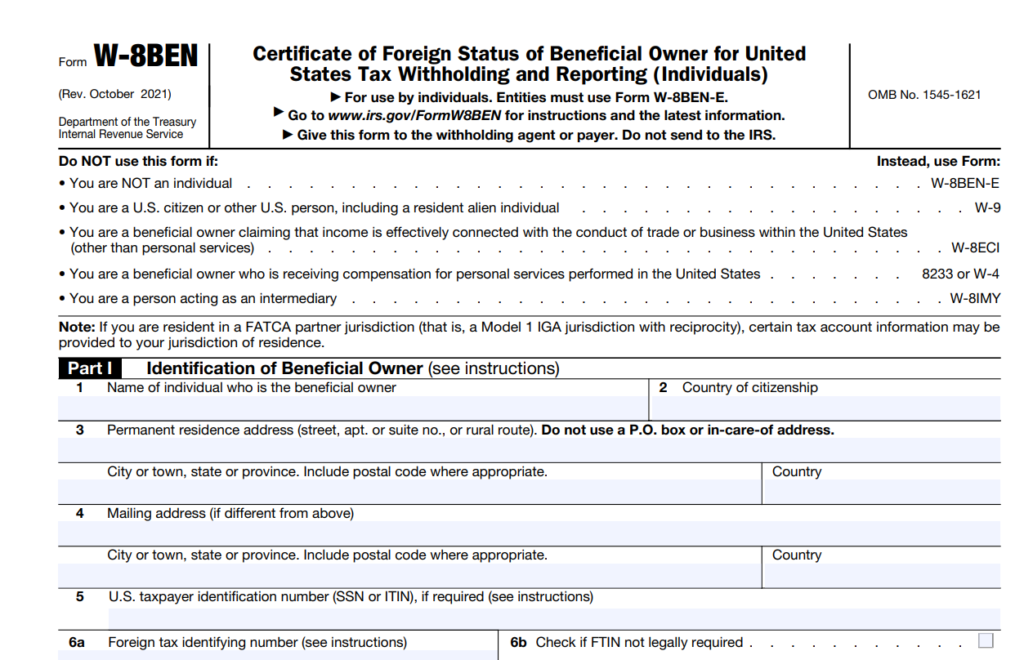
Form W-8BEN allows eligible foreign individuals to certify their status and claim reduced withholding on qualifying income.
When completing the form, you’ll need to:
- Provide Your Personal Information: Enter your legal name, country of citizenship, permanent residence address, and tax identification number.
- Identify Your Treaty Residence: Confirm that you’re a resident of Australia for purposes of the U.S.-Australia income tax treaty.
- Claim the Applicable Treaty Provision: Provide the additional treaty article, withholding rate, and eligibility information when the form requires it.
- Certify Beneficial Ownership: Confirm that you’re the beneficial owner of the income and that the information provided is accurate.
- Submit the Form to Your Payer: Give the completed form to your U.S. bank, brokerage, or other withholding agent before receiving the payment. Don’t send it directly to the IRS.
A Form W-8BEN typically remains valid through December 31 of the third calendar year after you sign it, unless a change in your information makes it incorrect. You’ll need to provide updated documentation when your residency or other relevant information changes.
How Do Australian Businesses Claim Reduced Withholding?
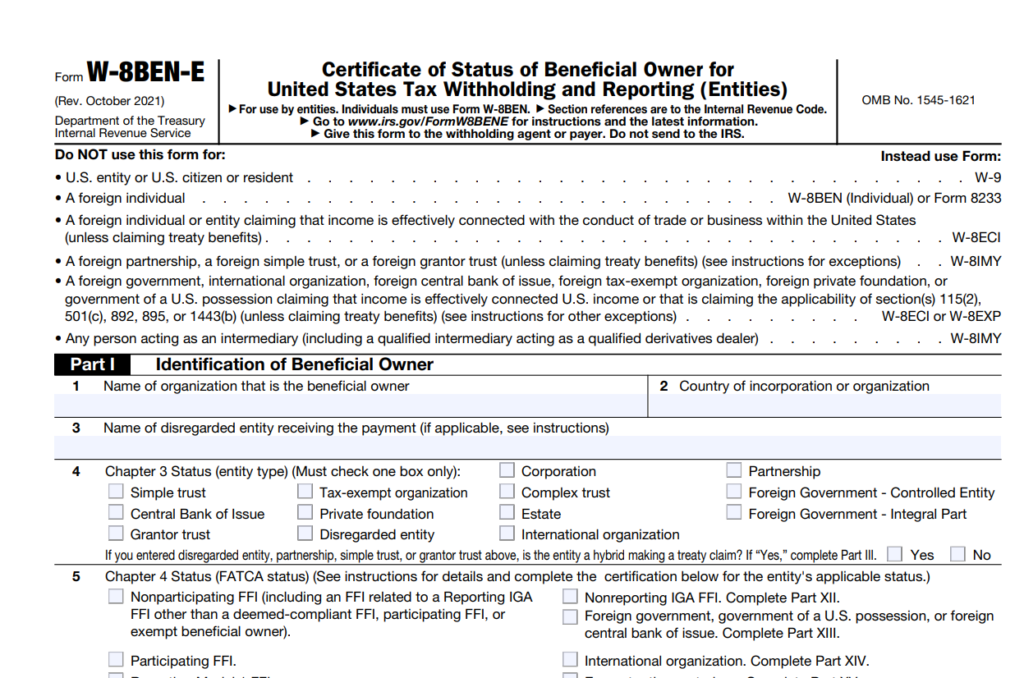
Australian companies and other eligible foreign entities use Form W-8BEN-E rather than Form W-8BEN. This form identifies the business, documents its foreign status, and establishes its eligibility for withholding exemptions or reduced treaty rates.
An Australian company claiming treaty benefits must provide the required entity information and identify the applicable limitation-on-benefits provision. The withholding agent uses this documentation to determine if the company qualifies for the claimed treatment.
What Happens if Too Much U.S. Tax Is Withheld?
If you haven’t submitted a valid withholding certificate, your U.S. payer may deduct tax at the standard 30% rate even when you qualify for a treaty reduction. Incorrect residency information, an expired form, or an unsupported treaty claim can also result in excessive withholding.
You may be able to recover the excess through a correction by the withholding agent or by filing a U.S. federal income tax return. Individual nonresident taxpayers commonly use Form 1040-NR to request refunds of excess withholding.
For many payments, your withholding agent issues Form 1042-S, which identifies the income paid, the withholding rate applied, and the federal tax deducted. You’ll need this information when reviewing your withholding or claiming a refund.
How Does the U.S.-Australia Tax Treaty Help Prevent Double Taxation?
Article 22 addresses situations where both countries have the right to tax the same income. Rather than eliminating one country’s taxing rights in every case, the treaty provides for tax credits that can reduce the amount payable in the taxpayer’s country of residence. The calculation depends on which country you live in, the income you receive, and the foreign taxes you’ve paid.
Foreign Tax Credits for Australian Residents
If you’re an Australian tax resident, you must ordinarily report your worldwide income on your Australian income tax return, including income earned from U.S. sources. When you’ve paid eligible U.S. income taxes on those earnings, you may qualify for Australia’s foreign income tax offset (FITO), which can reduce your Australian income tax liability. Only eligible foreign income taxes count toward the offset, and taxes exceeding the amount permitted under the treaty may not qualify.
Foreign Tax Credits for U.S. Taxpayers
U.S. citizens and resident aliens who pay Australian income taxes may qualify for foreign tax credits under the Internal Revenue Code and certain treaty provisions. These credits can reduce U.S. federal income tax on income that Australia also taxes.
However, the treaty’s saving clause preserves the United States’ right to tax its citizens and certain residents as though the treaty didn’t exist, subject to exceptions. This means U.S. citizens living in Australia may still need to report income from both countries on their federal tax returns.
Example of Double Taxation Relief
Suppose you’re an Australian resident who receives $10,000 in dividends from U.S. investments. Your American brokerage withholds $1,500 under the treaty’s 15% dividend rate, leaving you with $8,500.
You must ordinarily report the full $10,000 as foreign dividend income on your Australian return. You may then qualify for a foreign income tax offset based on the $1,500 paid to the IRS. The actual offset depends on your Australian tax liability and the FITO limit. The result is that the U.S. withholding tax may reduce the Australian income tax payable on those dividends, rather than leaving you liable for the full amount of tax in both countries.
How Do You Claim U.S.-Australia Tax Treaty Benefits on Your Tax Return?
If you’re an Australian resident with U.S. taxable income, you may need to file a federal income tax return to report your earnings, claim treaty exemptions, or recover excess tax payments. Your filing obligations depend on the income you’ve received, how it’s taxed, and the treaty provisions you’re claiming.
Filing Form 1040-NR as a Nonresident Taxpayer
Form 1040-NR, U.S. Nonresident Alien Income Tax Return, is used by nonresident alien individuals to report taxable U.S. income and calculate their federal income tax liability. You may need to file this return if you’ve earned income effectively connected with a U.S. trade or business, received income subject to additional U.S. tax, or need to claim a refund.
When preparing your return, you’ll need to distinguish between income taxable under U.S. domestic law and income exempt under the treaty. Form 1040-NR includes Schedule OI (Other Information), which asks taxpayers claiming treaty benefits to identify their treaty country, applicable treaty article, and exempt income.
For example, if you receive wages that qualify for an exemption under Article 15, you’ll need to report the treaty-exempt amount according to the Form 1040-NR instructions. Your return must distinguish those earnings from wages that remain subject to U.S. taxation.
When Is Form 8833 Required?
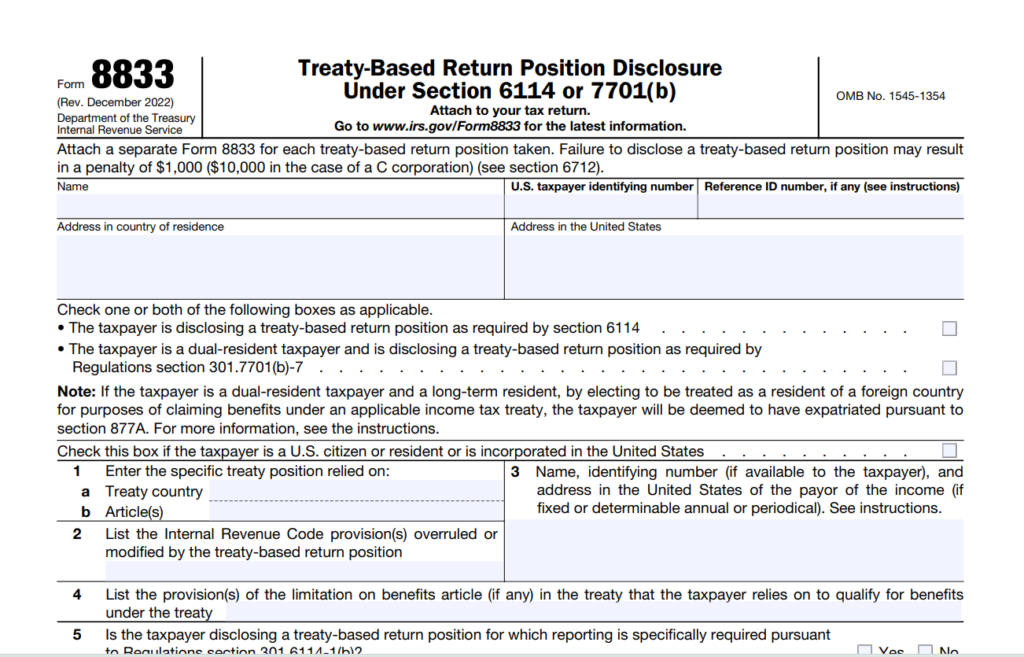
Form 8833 – Treaty-Based Return Position Disclosure Under Section 6114 or 7701(b), is used to disclose certain tax positions that rely on a treaty provision modifying the treatment required by the Internal Revenue Code.
Disclosure may be required when:
- Claiming Treaty Residency: You’re treated as a resident under U.S. domestic rules but claim Australian residency under the treaty, and the disclosure requirements are met.
- Changing Income Sourcing: You use a treaty provision to change how income is sourced for U.S. federal income tax purposes.
- Claiming Certain Foreign Tax Credits: You claim a credit for foreign taxes that wouldn’t qualify under the Internal Revenue Code without treaty relief.
- Reporting Certain Property Transactions: You claim treaty treatment that changes the taxation of gains or losses from U.S. real property interests.
Not every treaty claim requires Form 8833. Disclosure exceptions apply to qualifying reductions in withholding on dividends, interest, royalties, and certain personal service income, among other categories.
Note: Failing to submit Form 8833 when required can result in a $1,000 penalty for an individual taxpayer.
What Records Should You Keep to Support Your Treaty Claim?
The IRS may request documentation supporting the income and treaty treatment reported on your return. Maintaining records also helps you reconcile your U.S. tax filings with the income and foreign taxes reported in Australia.
Keep copies of:
- Income Documents: Forms W-2, 1042-S, 1099, investment statements, and business income records.
- Residency Records: Travel histories, immigration documents, housing records, and other information relevant to your treaty residence.
- Tax Payment Records: U.S. withholding statements, estimated tax payments, and Australian tax assessments.
- Employment and Business Agreements: Contracts identifying where services were performed, which entity paid compensation, and the nature of business operations.
- Previous Tax Returns: Copies of U.S. and Australian returns, treaty disclosures, and correspondence with tax authorities.
Your records should support the treaty provisions claimed and the amounts reported. If your residency, employment arrangements, or sources of income change, review their effect on your filings before preparing the next return.
Common Mistakes to Avoid When Claiming U.S.-Australia Tax Treaty Benefits
Errors can result in excessive withholding, additional federal income tax, penalties, or rejected refund claims. The following mistakes can create problems for Australian residents earning U.S.-source income.
| Common Mistake | Explanation |
| Claiming the Wrong Withholding Rate | Applying the 15% dividend rate to royalties or interest can result in incorrect withholding. Each income category has its own treaty provisions and eligibility conditions. |
| Misclassifying Income | Payments for consulting services, software licenses, and intellectual property transfers may receive different tax treatment. The nature of the payment determines which treaty article applies. |
| Overlooking Permanent Establishment Rules | An Australian company operating through a U.S. office or qualifying agent may have taxable business profits attributable to that presence. Sales to American customers must be distinguished from activities that establish a taxable U.S. business presence. |
| Using Incorrect Withholding Documentation | Submitting Form W-8BEN when Form 8233 is required for a personal services exemption can prevent the correct withholding treatment. The appropriate form depends on your income and the benefit claimed. |
| Failing to Disclose a Treaty Position | Certain claims require Form 8833 even when they reduce your U.S. income tax liability. Missing a required disclosure can result in penalties. |
| Assuming Treaty Relief Eliminates State Taxes | The treaty primarily addresses federal income taxation. You may still owe state income taxes, depending on where you earn income and state rules. |
| Claiming an Exemption for Income That Isn’t Taxed in Australia | Under Article 27, the treaty’s exemptions for employment, independent services, entertainer, and government income don’t apply to the extent the income isn’t subject to tax in Australia. The exemption is meant to prevent double taxation, not to make income untaxed in both countries. |
Get Help With U.S.-Australia Tax Treaty Compliance From USA Tax Gurus
The U.S.-Australia tax treaty can reduce withholding taxes, provide exemptions for certain income, and help prevent double taxation. However, you need to meet the applicable treaty conditions and comply with U.S. reporting requirements. Errors in income classification, withholding documentation, or treaty disclosures can result in tax liabilities, penalties, and delayed refunds.
At USA Tax Gurus, we help Australian residents, nonresident individuals, and international businesses meet their U.S. federal tax obligations. To discuss your cross-border tax situation and find out which treaty benefits may apply to you, book a meeting with us today or call 213-668-6316.
Frequently Asked Questions About the U.S.-Australia Tax Treaty
Do Australian Residents Have to Pay U.S. Taxes on American Income?
Australian residents may owe U.S. federal income tax on certain income earned from American sources, including dividends, rental income, and compensation for work performed in the United States. However, treaty provisions may reduce your tax liability or exempt qualifying income.
For example, U.S. dividends received by an eligible Australian resident are typically subject to 15% withholding instead of the standard 30%. Income from services performed entirely in Australia may not be subject to U.S. federal income tax under domestic sourcing rules. Your tax obligations depend on the income category, where you work, and the treaty provisions.
Does the U.S.-Australia Tax Treaty Apply to U.S. Citizens Living in Australia?
Yes, but the treaty generally does not exempt U.S. citizens living in Australia from U.S. federal tax on their worldwide income. Certain treaty provisions may provide limited relief, while foreign tax credits may help reduce double taxation on income taxed by both countries. The relief available depends on the type of income and individual circumstances.
Does the U.S.-Australia Tax Treaty Eliminate Double Taxation?
The U.S.-Australia tax treaty makes it possible to reduce double taxation, but it doesn’t exempt every type of cross-border income from tax in one country.
Article 22 addresses double taxation relief, including credits for eligible income taxes paid to the other country. For example, if you’re an Australian resident receiving U.S. dividends, you may qualify for reduced American withholding and an Australian foreign income tax offset for the eligible U.S. tax paid. However, foreign tax credits have calculation limits, and some income remains taxable in both countries. You’ll need to report the income and claim any available relief.
Can I Claim Treaty Benefits Without Filing a U.S. Tax Return?
Yes. Certain treaty benefits can be claimed directly through a U.S. withholding agent solely to obtain the reduced withholding rate.
For example, an Australian investor may submit Form W-8BEN to an American brokerage to claim the current treaty rate on qualifying dividends. However, you may still need to file Form 1040-NR if you have income requiring a U.S. return or want to recover excess withholding. Certain treaty positions also require disclosure using Form 8833. The filing requirements depend on your income, the benefit claimed, and your U.S. tax status.