
Key Takeaways:
- Form 3520-A is an annual reporting requirement for many foreign trusts with U.S. owners. It reports the trust’s income, assets, liabilities, ownership information, and certain distributions. U.S. owners are responsible for making sure the filing is completed when required.
- A person can be treated as a U.S. owner under the grantor trust rules even if the trust was created abroad, is administered by a foreign trustee, or holds no U.S. assets.
- Form 3520-A is due by the 15th day of the third month after the trust’s tax year ends. Calendar-year trusts generally have a March 15 deadline, and Form 7004 is used to request an extension.
- A U.S. owner may need both forms in the same year. Form 3520-A reports trust information, while Form 3520 reports certain ownership interests, transfers, distributions, and other transactions involving U.S. persons.
- A substitute Form 3520-A may be required if the foreign trust fails to file. The U.S. owner can prepare the substitute return, attach it to Form 3520, and include the required owner and beneficiary statements.
- A U.S. owner may face penalties based on the value of the trust assets treated as owned, with additional penalties possible for continued noncompliance. Reasonable-cause relief may be available when the applicable requirements are met.
If you’re the U.S. owner of a foreign trust, Form 3520-A can become an annual federal reporting obligation. This form gives the IRS information about the trust’s income, assets, liabilities, U.S. owners, and certain distributions to U.S. beneficiaries. Its filing rules can also require owner and beneficiary statements, and the deadlines don’t necessarily match the due date for your individual income tax return.
At USA Tax Gurus, we help taxpayers identify foreign trust reporting requirements and prepare the related U.S. filings. This article explains who must file, when the form is due, what information you’ll need, common filing errors, potential penalties, and how we can help you manage your foreign trust reporting obligations.
USA Tax Gurus is a team of enrolled agents and licensed CPAs who can help you save thousands on taxes. Schedule your free consultation today with a member of our team to learn more!
What Is Form 3520-A?
Form 3520-A – Annual Information Return of Foreign Trust With a U.S. Owner, is an annual IRS information return for foreign trusts that have at least one U.S. owner. It reports information about the trust’s income, assets, liabilities, U.S. owners, and certain distributions to U.S. beneficiaries. The filing may be necessary even when the trust doesn’t owe U.S. income tax for the year.
The form requires the following:
- Basic information about the trust
- A foreign trust income statement
- Balance sheet
- Statements for U.S. owners and beneficiaries
Income and financial information must be reported in U.S. dollars, which can involve currency conversion when the trust keeps its records in another currency.
Form 3520-A is different from Form 3520. Form 3520-A reports information about the foreign trust itself, while Form 3520 reports certain foreign trust transactions, ownership interests, distributions, and certain foreign gifts or bequests involving U.S. persons. If you’re treated as the U.S. owner of a foreign trust, you may have filing obligations involving both forms during the same tax year.
Who Must File Form 3520-A?
A foreign trust generally must file Form 3520-A if at least one U.S. person is treated as an owner of any portion of the trust under the federal grantor trust rules. The filing requirement can apply when the U.S. person owns the entire trust or only part of it. The key issue is tax ownership under U.S. law, not simply who holds legal title to the trust property.
A U.S. owner can include:
- A U.S. citizen
- Resident alien
- Domestic corporation
- Domestic partnership
- Another person treated as a U.S. person for federal tax purposes
Ownership is determined under Internal Revenue Code Sections 671 through 679. These rules can treat a U.S. person as the owner of trust assets when that person transferred property to the trust or retains certain powers, rights, or interests connected to the trust.
You can also be treated as an owner even if the trust was created under foreign law, administered by a foreign trustee, or holds no U.S. assets. If the trust has a U.S. owner, that owner is responsible for making sure Form 3520-A is filed, and the required statements are provided.
Note: When a trust has multiple U.S. owners, Form 3520-A must identify each owner and report the portion of the trust attributable to each one. Each U.S. owner may need a separate Foreign Grantor Trust Owner Statement showing that person’s share of trust income, expenses, and assets. Those amounts should match the related information reported on the owner’s Form 3520 and federal income tax return.
Because foreign trust ownership is determined under federal tax rules, you shouldn’t assume that the title used in the trust documents controls the filing requirement. Terms such as grantor, settlor, trustee, beneficiary, or protector may describe a person’s role under foreign law, but U.S. tax treatment can depend on different ownership rules.
Are There Exceptions to Form 3520-A Filing?
Some foreign trusts and trust-like arrangements qualify for relief from Form 3520-A reporting. The exemption depends on the type of arrangement and the federal requirements that apply to it. For example:
- Certain Canadian retirement plans receive relief under Revenue Procedure 2014-55. Qualifying Registered Retirement Savings Plans, or RRSPs, and Registered Retirement Income Funds, or RRIFs, generally aren’t subject to Form 3520 or Form 3520-A foreign trust reporting requirements.
- Revenue Procedure 2020-17 provides relief for certain tax-favored foreign trusts. It applies to certain eligible individuals who have transactions with or ownership interests in qualifying trusts established and operated exclusively or almost exclusively to provide pension, retirement, medical, disability, or educational benefits.
Proposed regulations under Internal Revenue Code Section 6048 provide further reporting relief for certain tax-favored foreign trusts. Taxpayers may rely on these proposed regulations for qualifying tax years if they and related persons apply the rules in their entirety and consistently from the first year of reliance until the final regulations become applicable.
Note: An exemption from Forms 3520 and 3520-A doesn’t necessarily remove your other U.S. reporting obligations. Depending on the account and assets involved, you may still have filing requirements under Form 8938, the FBAR, or other provisions of U.S. tax law.
If you’re unsure if an exception applies, USA Tax Gurus can review the foreign arrangement and determine which reporting requirements and exemptions apply before the applicable filing deadline.
When Is Form 3520-A Due?
Form 3520-A is due by the 15th day of the third month after the end of the foreign trust’s tax year. For a trust that uses a calendar year, the deadline is generally March 15. If the due date falls on a Saturday, Sunday, or legal holiday, the filing deadline moves to the next business day.
The foreign trust must also provide copies of the required Foreign Grantor Trust Owner Statements and Foreign Grantor Trust Beneficiary Statements to U.S. owners and U.S. beneficiaries by the Form 3520-A due date. A Form 3520-A isn’t considered properly filed unless it is complete and includes all required attachments.
Can You Extend the Form 3520-A Deadline?
A foreign trust can request an automatic six-month extension by filing Form 7004, Application for Automatic Extension of Time to File Certain Business Income Tax, Information, and Other Returns. Form 7004 must be filed by the regular Form 3520-A due date using the foreign trust’s employer identification number.
| Filing | Typical Deadline for Calendar-Year Filers | Extension |
| Regular Form 3520-A | March 15 | Form 7004 |
| Form 3520 | April 15 for many calendar-year individuals | Generally follows applicable income-tax-return extension rules |
| Substitute Form 3520-A | Filed with Form 3520 | Follows Form 3520 deadline |
Please note that an extension for your individual income tax return doesn’t extend the regular Form 3520-A filing deadline. If the trust needs additional time, it must file Form 7004 using the trust’s EIN.
What If the Trust Uses a Fiscal Year?
If the foreign trust uses a fiscal year instead of a calendar year, the deadline is based on the close of that tax year. Form 3520-A is due by the 15th day of the third month after the fiscal year ends.
Keeping the trust’s filing calendar separate from your personal tax calendar can prevent missed deadlines. At USA Tax Gurus, we can identify the applicable due dates, prepare extension requests, and coordinate the related owner and beneficiary statements with your other U.S. filings.
What Information Is Required on Form 3520-A?
Form 3520-A requires information about the foreign trust, its income, assets, liabilities, U.S. owners, and distributions to U.S. beneficiaries. All information must be provided in English, and all amounts must be reported in U.S. dollars. The return also includes separate statements for U.S. owners and U.S. beneficiaries when the applicable reporting requirements are met.
Part I: General Information About the Foreign Trust
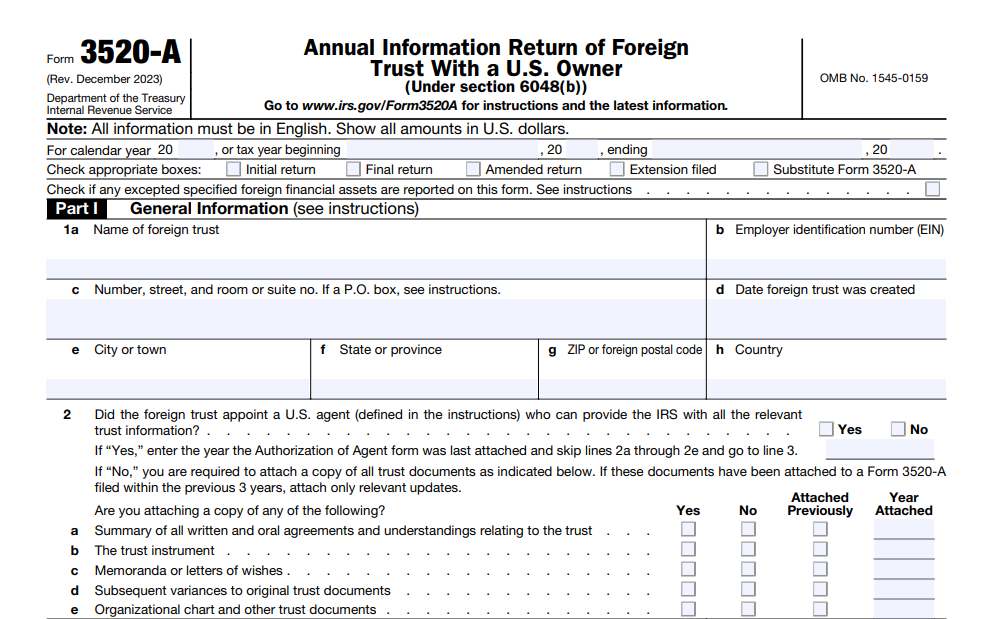
Part I identifies the foreign trust and provides information the IRS uses to associate the return with the correct trust and its U.S. reporting obligations. The form can require:
- Trust Name and Address: The foreign trust’s name and address must be reported.
- Employer Identification Number: The trust must use an EIN. An SSN or ITIN can’t be used in place of the trust’s EIN.
- U.S. Agent Information: If the trust has appointed a U.S. agent, the form reports the agent’s name, taxpayer identification number, and address.
- Owner Statements: The return reports the number of Foreign Grantor Trust Owner Statements included with Form 3520-A.
- Beneficiary Statements: The return reports the number of Foreign Grantor Trust Beneficiary Statements included with Form 3520-A.
If the foreign trust hasn’t appointed a U.S. agent, it must attach additional documents. They include:
- A summary of the trust terms
- Copies of trust documents and revisions
- Relevant letters or memoranda of wishes
- An organizational chart showing the ownership arrangement and percentages
If the required documents were attached to a Form 3520-A filed within the previous three years, only relevant updates need to be attached.
Part II: Foreign Trust Income Statement
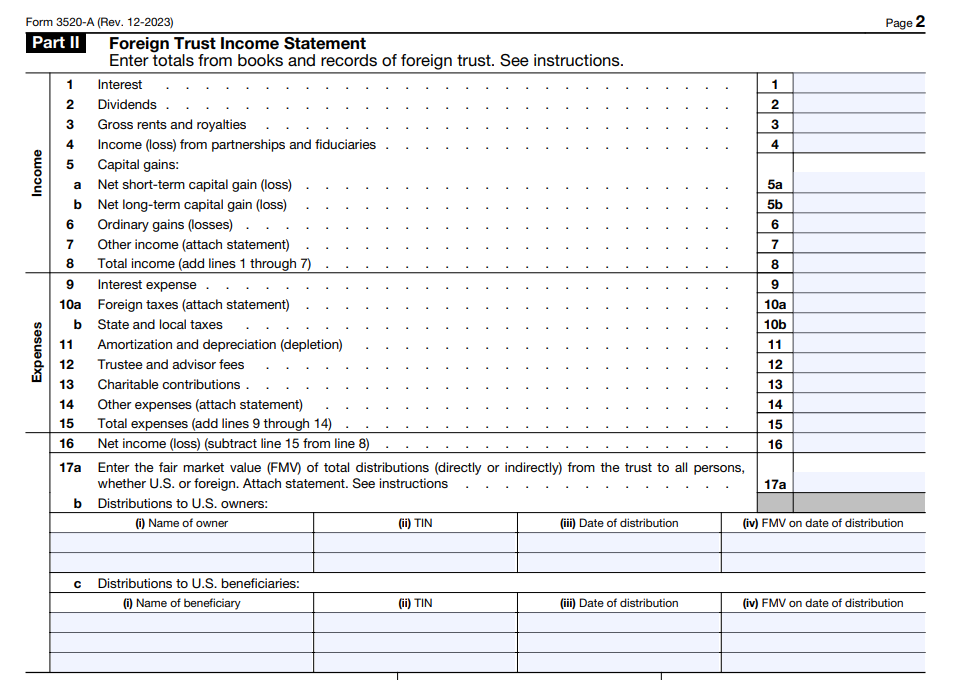
Part II reports income from U.S. and non-U.S. sources. The financial statement must reasonably reflect the trust’s income under U.S. income tax principles, so records prepared under foreign accounting or tax rules may need adjustments before the amounts are reported.
Reportable items can include:
- Interest
- Dividends
- Income or losses from partnerships and other pass-through entities
- Capital gains and losses
- Ordinary gains and losses
- Other income
- Interest expense
- Foreign taxes
- State and local taxes
- Depreciation and amortization
- Trustee and advisor fees
- Charitable contributions
- Other deductible expenses
Form 3520-A also reports trust distributions. Distributions to each U.S. owner and U.S. beneficiary must be listed separately with the recipient’s full name, taxpayer identification number, distribution date, and fair market value on the date of distribution.
The return can also require an attached statement describing transfers made by the trust. Depending on the transaction, that statement can include the property transferred, estimated fair market value, adjusted basis, consideration received, parties involved, subsequent transfers, and the trust’s ownership interests in other entities.
Part III: Foreign Trust Balance Sheet
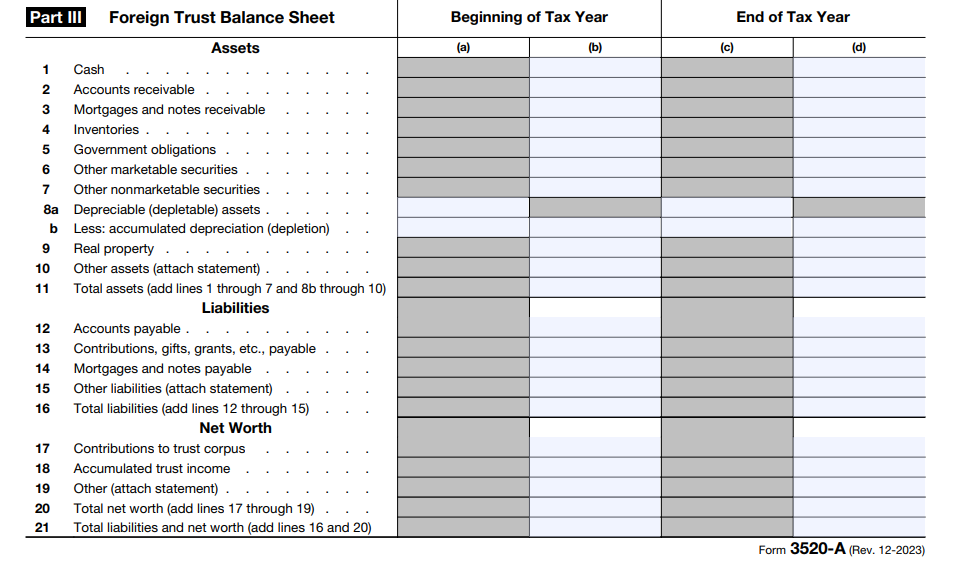
Part III reports all assets and liabilities of the trust, including assets and liabilities attributable to portions that aren’t treated as owned by a U.S. person. The balance sheet should reflect fair market value.
Items can include:
- Cash and certificates of deposit
- Marketable securities
- Receivables
- Mortgages and notes receivable
- Interests in businesses or other entities
- Real estate
- Other trust assets
- Accounts payable
- Mortgages and notes payable
- Other liabilities
- Accumulated trust income
You don’t have to reconcile differences between the book basis and tax basis of assets and liabilities for Part III. However, the balance-sheet amounts should reflect fair market value as required by the Form 3520-A instructions.
Converting Foreign Currency to U.S. Dollars
Foreign trustees may maintain records in another currency, but Form 3520-A requires all amounts to be reported in U.S. dollars. You should retain records showing the original amounts and the exchange-rate calculations used to prepare the U.S. filing.
The financial information reported on Form 3520-A also affects the statements provided to U.S. owners and beneficiaries. USA Tax Gurus can review foreign trust records, identify the information needed for the return, and prepare the filing using the applicable U.S. reporting rules.
What Is the Foreign Grantor Trust Owner Statement?
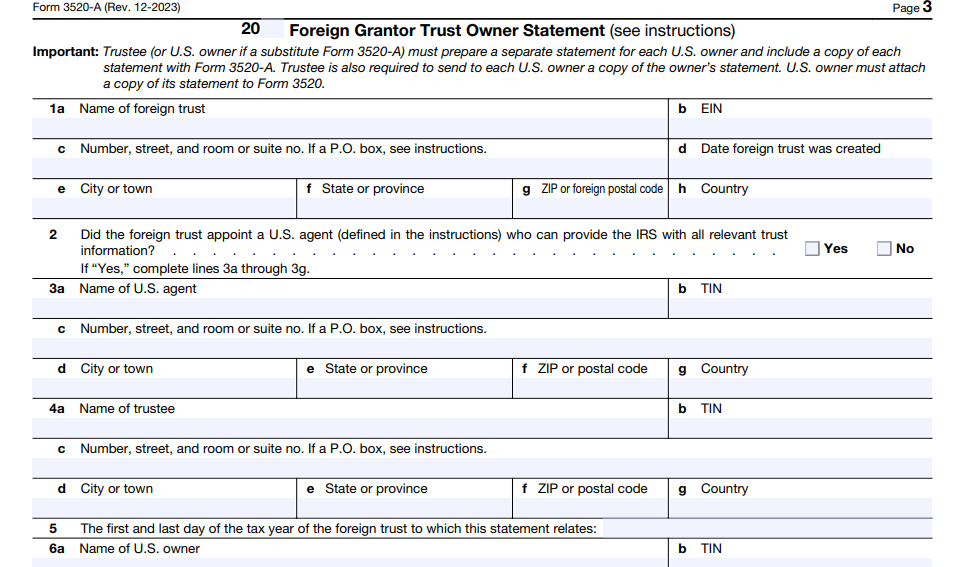
The Foreign Grantor Trust Owner Statement must be prepared for each U.S. person treated as an owner of any portion of the foreign trust. A copy of the statement must be included with Form 3520-A and furnished to the applicable U.S. owner by the filing deadline.
The statement identifies the foreign trust and the U.S. owner and reports information connected to the portion of the trust treated as owned by that person. It also includes a Statement of Foreign Trust Income Attributable to U.S. Owner, which reports the portion of trust income attributable to the U.S. owner. Those amounts can affect what the owner reports on a U.S. federal income tax return.
Information reported on the owner statement can include:
- Trust Identification: The trust’s name, EIN, address, and tax year.
- U.S. Owner Information: The owner’s name, taxpayer identification number, and address.
- Trust Income Attributable to the Owner: The portion of trust income treated as attributable to that U.S. owner.
- Trust Expenses: Expenses connected to the portion of trust income attributable to the owner.
- Trust Documents: If the trust hasn’t appointed a U.S. agent, the statement identifies documents attached to the current return or a Form 3520-A filed within the previous three years.
The foreign trust may also need to provide the U.S. owner with additional statements or records that aren’t fully shown on the owner statement. The IRS instructions state that this additional information may be needed so the owner can accurately report trust income and expenses on the owner’s U.S. income tax return.
The deadline for providing the statement generally matches the Form 3520-A filing deadline. For a calendar-year trust, that is generally March 15, subject to weekends, legal holidays, and an approved extension. If the U.S. owner files a substitute Form 3520-A, the statement is furnished by the due date of the owner’s Form 3520.
Because the owner statement connects the trust’s reporting with the U.S. owner’s tax return, inconsistent amounts can create additional filing problems. USA Tax Gurus can prepare the owner statement together with Form 3520-A, Form 3520, and the related income tax return so the same ownership and income information is reported consistently.
When Is a Foreign Grantor Trust Beneficiary Statement Required?
A Foreign Grantor Trust Beneficiary Statement must be prepared for each U.S. beneficiary who receives a direct or indirect distribution from a foreign grantor trust during the tax year. A copy of the statement must be included with Form 3520-A and furnished to the U.S. beneficiary by the applicable filing deadline.
The statement gives the beneficiary information needed to determine the U.S. tax treatment of the distribution and complete Form 3520 when required. It includes:
- Trust Information: The foreign trust’s identifying information and tax year.
- Beneficiary Information: The U.S. beneficiary’s name, taxpayer identification number, and address.
- Distribution Information: A description of the cash or property distributed or deemed distributed during the year and its fair market value.
- Grantor Trust Explanation: An explanation of the facts necessary to establish that the foreign trust is treated as owned by another person for U.S. tax purposes, including the applicable Internal Revenue Code provision.
- Owner Type: Identification of the trust owner as an individual, trust, corporation, or partnership.
- U.S. Agent Information: If the trust appointed a U.S. agent, the statement provides the agent’s name, address, and taxpayer identification number.
- Access to Trust Records: If the trust hasn’t appointed a U.S. agent, the statement must state that the IRS or U.S. beneficiary may inspect and copy records needed to establish the trust’s treatment as owned by another person.
There is an exception for a U.S. person who is treated as the owner of the portion of the trust from which the distribution is made. The trust doesn’t prepare a Foreign Grantor Trust Beneficiary Statement for that portion. Instead, it prepares a Foreign Grantor Trust Owner Statement for that person.
If a U.S. beneficiary receives a complete Foreign Grantor Trust Beneficiary Statement, the beneficiary generally treats the distribution for U.S. income tax purposes as if it came directly from the trust owner. For example, if the distribution is treated as a gift from the owner, the beneficiary doesn’t include it in gross income solely because it passed through the foreign trust.
Note: The statement generally must be provided by the Form 3520-A filing deadline. If a U.S. owner files a substitute Form 3520-A, copies of the beneficiary statements must instead be provided to the applicable U.S. beneficiaries by the due date of the owner’s Form 3520.
What Happens If the Foreign Trustee Doesn’t File Form 3520-A?
A foreign trustee’s failure to file Form 3520-A doesn’t remove the U.S. owner’s reporting responsibility. If the foreign trust fails to file the return, the U.S. owner must generally prepare a substitute Form 3520-A and attach it to the owner’s Form 3520. The substitute filing supplies the information the foreign trust was required to report to the IRS.
How Do You File a Substitute Form 3520-A?
The U.S. owner must complete the substitute Form 3520-A to the best of their ability. The filing should include:
- The Completed Form 3520-A: Check the “Substitute Form 3520-A” box at the top of the form.
- Foreign Grantor Trust Owner Statement: Include the required owner statement for each applicable U.S. owner.
- Foreign Grantor Trust Beneficiary Statement: Include beneficiary statements for applicable U.S. beneficiaries.
- Form 3520: Attach the complete substitute Form 3520-A to the U.S. owner’s Form 3520.
- Required Copies: Provide copies of the owner and beneficiary statements to the applicable U.S. owners and beneficiaries by the Form 3520 due date.
The U.S. owner must sign and date the substitute Form 3520-A. The owner’s name and taxpayer identification number must be entered on the “Title” line of the signature box.
When Is a Substitute Form 3520-A Due?
A substitute Form 3520-A follows the due date for the U.S. owner’s Form 3520 rather than the regular Form 3520-A deadline. For a calendar-year individual, Form 3520 is generally due April 15. If the individual receives an extension of time to file the income tax return, Form 3520 is generally due no later than October 15, and the substitute Form 3520-A attached to it follows that deadline.
This rule is different from the deadline for a regular Form 3520-A. A regular return for a calendar-year foreign trust is generally due March 15, while a substitute Form 3520-A attached to Form 3520 follows the Form 3520 deadline.
Why Is the Substitute Filing Important?
The IRS states that a U.S. owner must timely attach a completed substitute Form 3520-A to Form 3520 to avoid the penalty associated with the foreign trust’s failure to timely file Form 3520-A. The substitute can be completed to the best of the U.S. owner’s ability, which is relevant when records are controlled by a foreign trustee.
Waiting for a foreign trustee to act can create filing problems if the trustee is unfamiliar with U.S. tax requirements, doesn’t respond to document requests, or provides records after the filing deadline. At USA Tax Gurus, we can review the available trust records, determine if a substitute Form 3520-A is required, and coordinate it with your Form 3520 and related U.S. tax filings.
Form 3520-A and Form 3520: Why U.S. Owners May Need Both
| Form | Form 3520 | Form 3520-A |
| Main purpose | Reports certain foreign trust transactions, ownership and foreign gifts/bequests | Annual information return for a foreign trust with a U.S. owner |
| Who is responsible | U.S. person | Foreign trust, with responsibility on the U.S. owner to make sure it is filed |
| Typical calendar-year timing | Generally April 15 for many individuals | Generally March 15 |
| Can both apply? | Yes | Yes |
A U.S. person treated as the owner of any portion of a foreign trust generally must complete Part II of Form 3520. This requirement can apply even if the trust made no distributions and the U.S. owner had no other reportable transactions with the trust during the year. The owner must identify the foreign trust and report the portion treated as owned under the grantor trust rules.
Form 3520 can also be required when a U.S. person:
- Creates or Transfers Property to a Foreign Trust: Certain transfers of money or property to a foreign trust must be reported.
- Receives a Distribution: Direct or indirect distributions from a foreign trust can trigger Form 3520 reporting.
- Is Treated as the Owner: A U.S. person treated as owning part or all of a foreign trust generally has an annual reporting obligation.
- Receives Certain Foreign Gifts or Bequests: Form 3520 also reports certain gifts or bequests received from foreign persons, even when no foreign trust is involved.
The information reported on Forms 3520 and 3520-A should be consistent. Trust ownership percentages, distributions, income, identifying information, and other reportable amounts can appear across both forms and on the U.S. owner’s income tax return. Inconsistencies can lead to IRS questions and may need to be corrected, depending on the error.
At USA Tax Gurus, we can prepare Forms 3520 and 3520-A together so the ownership information, distributions, income, and filing dates are handled consistently across the related U.S. tax filings.
Common Form 3520-A Filing Mistakes
Form 3520-A has several reporting requirements that can create problems when trust records, filing deadlines, and related U.S. tax forms aren’t reviewed together. Because the U.S. owner is responsible for making sure the foreign trust files a complete return, errors by a foreign trustee can also affect the U.S. owner.
- Assuming the Foreign Trustee Is Responsible for Everything: A foreign trust with a U.S. owner must file Form 3520-A, but each U.S. owner is responsible for making sure the return is filed and the required annual statements are provided. If the foreign trust doesn’t file, the U.S. owner may need to prepare a substitute Form 3520-A.
- Confusing Form 3520 With Form 3520-A: The two forms have different purposes and separate filing requirements. A U.S. owner may need to complete Part II of Form 3520 while also making sure the foreign trust files Form 3520-A.
- Missing the Regular Form 3520-A Deadline: Form 3520-A is due by the 15th day of the third month after the trust’s tax year ends. For a calendar-year trust, that deadline is generally March 15, which arrives before the usual April filing deadline for an individual U.S. taxpayer.
- Using the Wrong Extension: Extending your individual income tax return doesn’t extend the regular Form 3520-A deadline. The foreign trust must file Form 7004 by the Form 3520-A due date if it needs additional time.
- Failing to File a Substitute Form 3520-A: If the foreign trust doesn’t file Form 3520-A, the U.S. owner must complete a substitute Form 3520-A and attach it to Form 3520 to avoid being subject to the penalty for the foreign trust’s failure to file. The substitute follows the Form 3520 deadline rather than the regular Form 3520-A deadline.
- Leaving Out Required Owner or Beneficiary Statements: Form 3520-A includes Foreign Grantor Trust Owner Statements and Foreign Grantor Trust Beneficiary Statements when applicable. A U.S. owner can face a Section 6677 penalty if the trust fails to furnish required information or reports incorrect information.
- Using an SSN or ITIN Instead of the Trust’s EIN: Form 3520-A requires the foreign trust’s EIN. An SSN or ITIN shouldn’t be used in place of the trust’s EIN.
- Reporting Foreign Records Without Applying U.S. Tax Rules: Part II must reasonably reflect trust income under U.S. income tax principles. Financial records prepared under foreign tax or accounting rules may need adjustments before the amounts are reported on Form 3520-A.
- Failing to Report All Trust Assets and Liabilities: Part III requires the trust to report all assets and liabilities, including amounts attributable to portions that aren’t treated as owned by a U.S. person. The balance sheet should reflect fair market value.
- Reporting Different Information Across Related Tax Returns: A U.S. owner’s or beneficiary’s tax return must be consistent with Form 3520-A unless the inconsistent treatment is disclosed to the IRS. Form 8082 is used when the taxpayer reports an item differently from the way the foreign trust reported it.
- Assuming a Foreign Retirement or Savings Arrangement Is Exempt: Some qualifying foreign retirement and tax-favored trusts receive relief from Forms 3520 and 3520-A, but the exemption depends on the applicable federal requirements. Treating an arrangement as exempt without confirming that it qualifies can result in a missed filing.
- Ignoring Related International Reporting Requirements: Relief from Form 3520-A doesn’t automatically eliminate other U.S. tax filings. Depending on the assets and accounts involved, Form 8938, FBAR reporting, income reporting, or another international information return may still apply.
Reviewing these issues before filing can reduce the risk of a late, incomplete, or inconsistent return. At USA Tax Gurus, we can review the trust records and related U.S. filings to identify missing information before Form 3520-A is submitted.
What Are the Penalties for Failing to File Form 3520-A?
The penalties for failing to file Form 3520-A can be substantial because they’re based partly on the value of the foreign trust assets treated as owned by the U.S. person. A penalty can apply when the foreign trust files late, omits required information, provides incorrect information, or fails to furnish required annual statements.
What Is the Initial Form 3520-A Penalty?
If the applicable gross reportable amount is at least $10,000, a U.S. owner can face an initial penalty equal to the greater of:
- $10,000, or
- 5% of the gross value of the portion of the foreign trust’s assets treated as owned by the U.S. person at the end of the tax year.
If the gross reportable amount is less than $10,000, the initial penalty is limited to that gross reportable amount.
For this purpose, the gross reportable amount is the gross value of the portion of the trust’s assets treated as owned by the U.S. person at the close of the tax year. Liabilities aren’t deducted when calculating that value.
The initial penalty can apply if the foreign trust:
- Fails to file Form 3520-A on time
- Fails to furnish required information under Internal Revenue Code Section 6048(b)
- Reports required information incorrectly
- Fails to provide required annual statements to U.S. owners or beneficiaries
A timely substitute Form 3520-A can prevent the U.S. owner from being subject to the penalty for the foreign trust’s failure to file. The substitute must be completed to the best of the owner’s ability and attached to Form 3520 by the Form 3520 due date.
Can Additional Penalties Apply?
Yes. If the IRS sends notice of a failure to comply and the reporting problem continues beyond 90 days, an additional penalty of $10,000 can apply for each 30-day period, or fraction of a period, after the 90-day period expires.
If the IRS can determine the gross reportable amount, the aggregate Section 6677 penalties are limited so they don’t exceed that amount.
Can Other Penalties Apply?
Other penalties can apply when foreign trust reporting problems affect related tax filings. If a U.S. owner is subject to the 20% accuracy-related penalty under Section 6662 for an underpayment, that penalty can increase to 40% under Section 6662(j) for a portion of the underpayment attributable to a transaction involving an asset for which Form 3520-A information was required.
Note: Criminal penalties can also apply under Sections 7203, 7206, and 7207 for conduct that meets the requirements of those provisions, including certain failures to file and false or fraudulent returns.
Is Reasonable Cause Relief Available?
Section 6677 penalties won’t be imposed if you can establish that the failure resulted from reasonable cause and not willful neglect. Reasonable cause depends on your conduct and the events surrounding the missed or incorrect filing.
If you receive a Form 3520-A penalty notice or discover a prior filing problem, USA Tax Gurus can review the affected tax years, trust records, related filings, and available documentation. We can also prepare corrective filings and evaluate the information that may support a reasonable-cause position.
What If You Already Missed a Form 3520-A Filing?
If Form 3520-A should have been filed for a prior year, you may need to prepare a delinquent or substitute filing and review any related Form 3520 requirements.
If penalties have been assessed, USA Tax Gurus can also help evaluate whether reasonable-cause relief may be available based on your circumstances.
Get Help With Form 3520-A and Foreign Trust Reporting
Form 3520-A can create annual reporting duties for U.S. owners of foreign trusts, and those duties can extend beyond the trust return itself. You may also need Form 3520, owner or beneficiary statements, related international information returns, and income tax reporting that uses the same trust data.
At USA Tax Gurus, we can review your ownership interest, trust records, filing history, and related U.S. tax returns to determine which forms apply. We can also prepare Form 3520-A, Form 3520, substitute filings, required statements, and delinquent returns when needed. Book a meeting with us today or call 213-668-6316 and see how we can help.
Frequently Asked Questions About Form 3520-A
Does a Foreign Trust Need a U.S. Bank Account to Trigger Form 3520-A?
No. Form 3520-A filing depends on the trust’s classification as a foreign trust and the presence of at least one U.S. owner under the grantor trust rules. The trust doesn’t need a U.S. bank account, U.S. real estate, or U.S.-source income for the filing requirement to apply.
A trust administered entirely outside the United States can still have a Form 3520-A filing obligation if a U.S. person is treated as owning all or part of it. The location of the trust’s assets doesn’t determine the filing requirement by itself.
Does Form 3520-A Reporting Change If the Trust Owns a Foreign Corporation or Partnership?
It can. Form 3520-A must report the trust’s assets and income, which can include interests in foreign corporations, partnerships, or other entities.
Separate international information returns may also apply depending on the ownership percentage, attribution rules, entity type, and the U.S. persons involved. Forms such as Form 5471 or Form 8865 may be required when their separate filing requirements are met. These filings should be reviewed together so ownership and income information are reported consistently.
Can Form 3520-A Apply After the Original Grantor Dies?
Yes. The original grantor’s death doesn’t automatically end all foreign trust reporting. The trust’s tax treatment may change after death based on the trust terms and the applicable grantor and nongrantor trust rules.
A trust that was treated as a grantor trust during the grantor’s lifetime may have different reporting obligations afterward. That change can affect Form 3520-A, Form 3520, beneficiary reporting, and the U.S. tax treatment of later distributions. The trust’s classification should be reviewed again after the grantor’s death.